
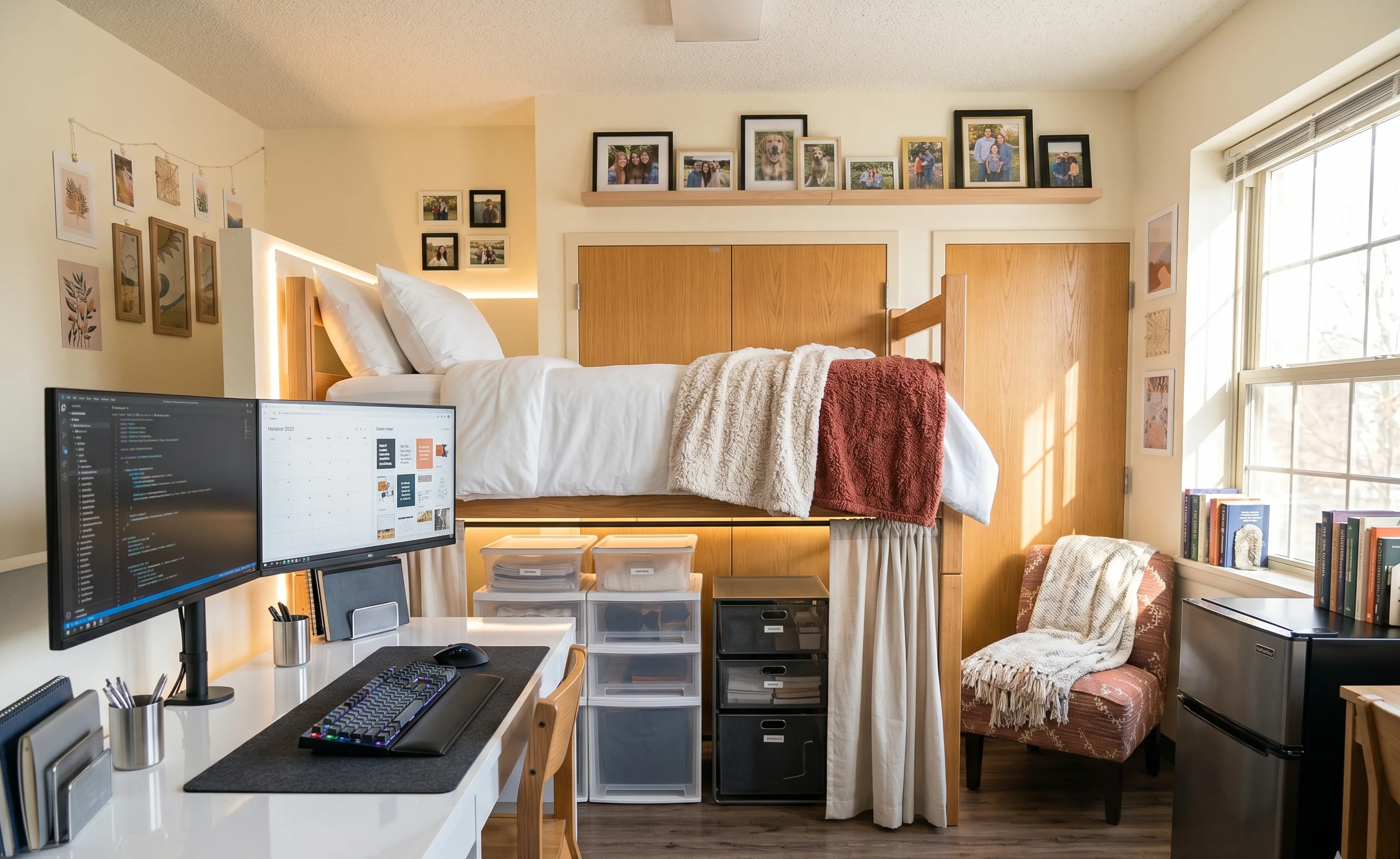
1. The Day I Arrived at My Dorm (And Panicked)
Dorm room setup is one of those things nobody warns you about properly. I remember rolling up to my freshman dorm with two overstuffed suitcases, a box fan, and way too much confidence. I opened the door to my new room and just… stood there. It was a 12×10 foot box with a standard-issue bed frame, a desk that looked older than my parents, and exactly zero storage.
My roommate hadn’t arrived yet, so I had one shot at claiming the better side — and I completely blew it. I threw my stuff on the bed nearest the window (rookie win) but then piled everything in a chaotic heap and spent the next three weeks living in a disaster zone.
By sophomore year, I’d learned. By junior year, my dorm was legitimately cool. People would come over just to hang out. If I’d known then what I know now about a proper dorm room setup, I could’ve had that vibe from day one.
This guide is everything I wish someone had told me — not generic advice, but real, tested stuff that actually works in a tiny college dorm.
| 🎯 Focus: Your dorm room setup affects your sleep, your grades, and your mental health more than most students realize. Getting it right from the start is worth every minute you invest. |
2. Planning Your Dorm Room Setup Before You Even Arrive

The biggest mistake most students make? They show up on move-in day with zero plan and figure it out on the fly. That’s how you end up with a desk in the weirdest possible spot and no room to walk.
Get the Dimensions First
Most universities list the exact dimensions of their dorm rooms on housing websites. Hunt that page down. Then get a piece of graph paper and sketch a rough floor plan. It sounds obsessive, but trust me — knowing that your room is 10×12 before you arrive tells you exactly how much furniture will actually fit.
Standard dorm rooms are usually around 180–200 square feet for a double, and roughly 100–120 square feet for a single. Every inch counts.
Use a Room Planning App
I used Roomstyler (free, browser-based) to virtually arrange furniture before move-in day. There’s also IKEA’s room planner and a phone app called MagicPlan that can scan a room and generate a floor plan automatically. These tools are genuinely useful — not just for fun.
Coordinate With Your Roommate
If you have a roommate, get on a group chat early. Decide who’s bringing what. You do not need two mini fridges and zero desk lamps. Split the big shared items: one fridge, one microwave, one TV if you want one, and a rug or two that match (or at least don’t clash completely).
| 💡 Pro Tip: Check your school’s prohibited items list before packing. Most dorms ban open-coil hot plates, halogen lamps, and candles. Getting something confiscated on move-in day is a rough way to start the semester. |
3. The Furniture Game: What to Keep, What to Ditch
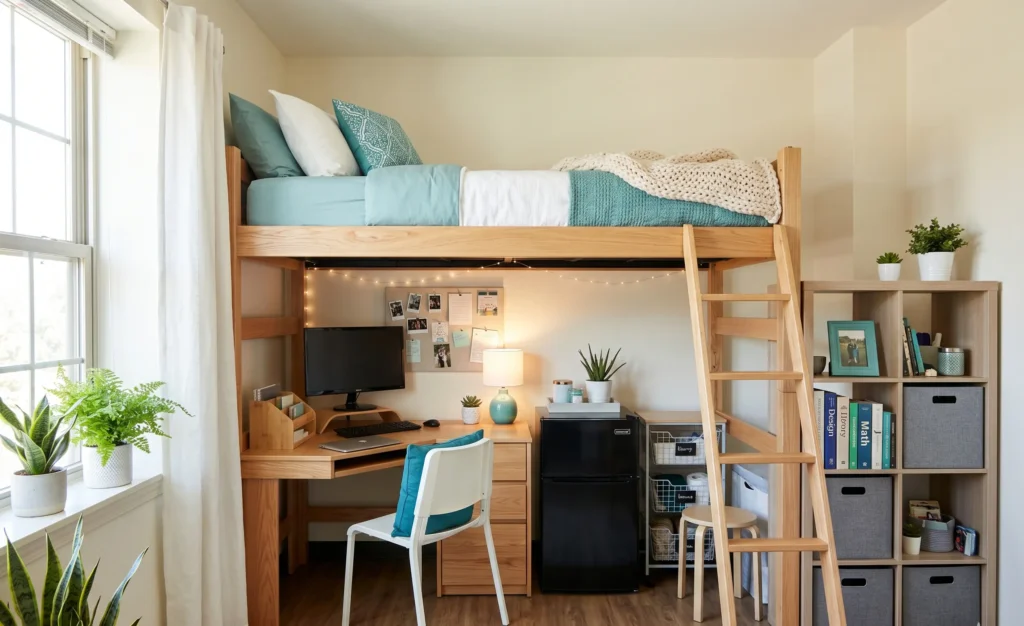
Dorm furniture is almost always ugly and barely functional. The good news: most schools let you rearrange it, push it against walls, or even loft the bed. Here’s what to actually do with what you’ve got.
Loft That Bed
Lofting your bed is one of the best things you can do for a dorm room setup. It immediately creates an entire “room” underneath — enough space for a mini fridge, a small sofa or papasan chair, a bookshelf, or extra storage bins. Some schools provide lofting kits; others let you bring bed risers.
Bed risers cost about $15–30 on Amazon and can raise a bed 7–8 inches. Lofting kits can take it to 5–6 feet off the ground. I did this sophomore year and it genuinely doubled my usable floor space.
Ditch the Furniture You Won’t Use
Most dorm rooms come with two dressers. If you and your roommate can share one, put the second one in the hallway or ask facilities to remove it. That’s an extra 3×2 foot chunk of floor space you just reclaimed. Same goes for extra chairs — the default desk chair is uncomfortable anyway; swap it for something better or add a seat cushion.
Add a Command Center Shelf
A floating shelf above your desk — the kind that attaches with Command strips or tension rods — creates vertical storage without damaging walls. IKEA’s LACK shelf is cheap, lightweight, and looks clean. Put your router, a power strip, and your most-used books up there.
| ⚠️ Warning: Some dorms prohibit drilling into walls. Always use damage-free hanging hardware like 3M Command strips, tension rods, or over-door hooks. Read the housing contract fine print. |
4. Tech Gear That Actually Makes a Difference
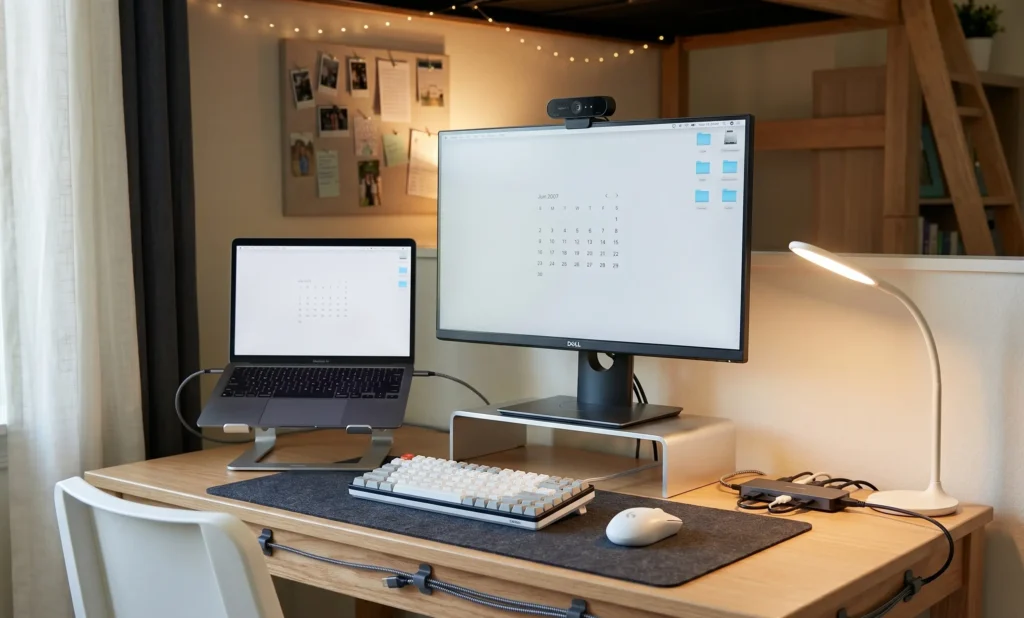
This is the section I could talk about for hours. Getting your tech right in a dorm room isn’t about buying the most expensive stuff — it’s about buying the right stuff for a small, shared, multi-purpose space.
The External Monitor Is Non-Negotiable
If you’re doing any serious coursework — essays, research, coding, design — a second screen is a game changer. You don’t need anything fancy. A 24-inch 1080p monitor from brands like ASUS, Acer, or LG runs $130–180 and makes you dramatically more productive. Pair it with a monitor arm or stand to free up desk space.
I used a Dell 24-inch monitor all through college. It sounds like a small thing until you’ve spent 6 hours writing a research paper with your laptop screen alone — then suddenly it’s life-changing.
A USB-C Hub Is Essential
Most modern laptops have a limited number of ports. A USB-C hub solves this for $25–40. Get one with at least three USB-A ports, an HDMI port, an SD card slot, and a charging pass-through. Anker and Satechi make reliable ones.
Cable Management Makes Everything Look Better
Here’s something I learned late: cable chaos makes a small room feel even smaller. A pack of cable clips and velcro ties ($8 on Amazon) combined with a cable management box or tray transforms a messy desk into something that actually looks put together. Run cables along the back of your desk, clip them down, and hide the power strip under or behind.
Smart Plug for Shared Spaces
A Kasa or TP-Link smart plug lets you control things like a desk fan, a salt lamp, or a string light with your phone or voice (if you use Alexa or Google Home). It’s a small upgrade that makes the room feel a little more “yours.”
Recommended Tech Checklist
- External monitor (24-inch, 1080p) — ASUS VA24EHE or similar
- USB-C hub with HDMI and charging pass-through — Anker 341
- Surge protector with USB ports — Belkin 12-outlet or similar
- Wireless keyboard and mouse — Logitech MK470 combo
- Cable management clips and velcro ties
- Smart plug — Kasa EP10 (works with Alexa + Google)
- Laptop stand or monitor arm — BenQ ScreenBar compatible
- Bluetooth speaker — JBL Clip 4 (small but loud)
5. Lighting: The Most Underrated Part of Any Dorm Room Setup
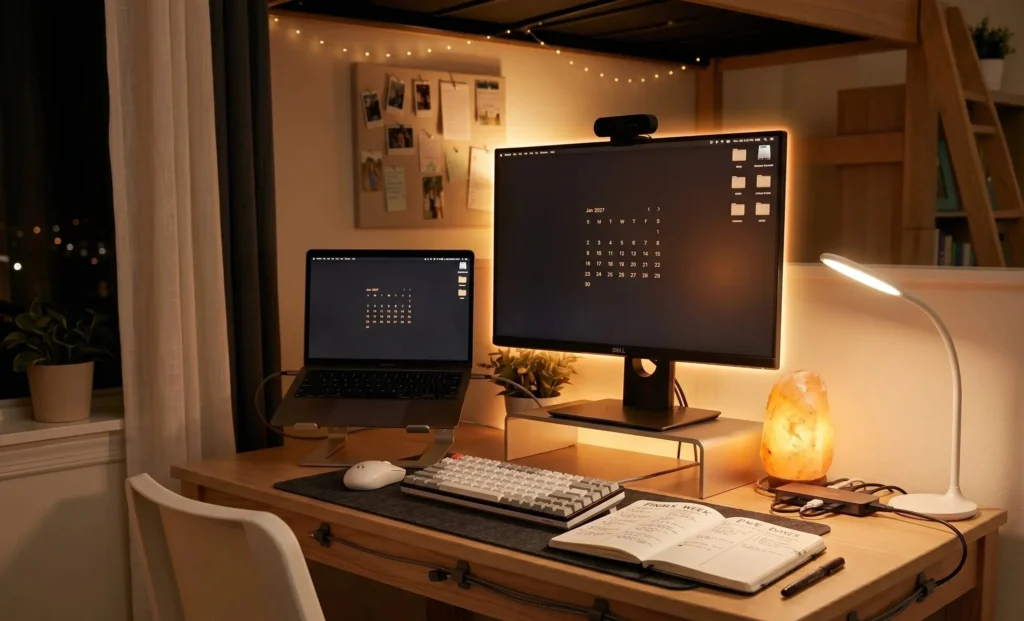
I genuinely believe bad lighting ruins more dorm rooms than any other single factor. That single overhead fluorescent tube that comes standard in most dorms? It’s exhausting. It makes everything look like a DMV waiting room. And studying under it at 11 PM is a special kind of miserable.
Layer Your Lighting
Good lighting comes in layers: ambient (overall room light), task (focused light for studying), and accent (mood and aesthetic). Most dorms only give you ambient, and it’s terrible. Add the other two and the whole room transforms.
LED Strip Lights
Govee and Philips Hue Play LED strips ($20–40) can go under your lofted bed, behind your monitor, or along the top of a bookshelf. They’re app-controlled, let you pick from millions of colors, and sync to music if you’re into that. I had Govee strips running in my junior year dorm and literally everyone who visited asked about them.
A Good Desk Lamp
Don’t cheap out on a desk lamp. Something with adjustable color temperature (so you can go warm yellow for evenings and cool white for studying) makes a real difference. The BenQ e-Reading Lamp is beloved by students and remote workers alike for a reason — it illuminates your entire desk without glare. It costs around $109, which sounds like a lot, but your eyes will thank you.
If budget is tight, the TaoTronics TT-DL16 is a solid $30 alternative with USB charging built in.
Salt Lamp or Small Accent Light
A Himalayan salt lamp or a small Edison bulb lamp on a shelf creates warm ambient light that makes the room feel cozy instead of institutional. These run $15–25 and work on a smart plug so you can control them without getting out of bed.
| 💡 Lighting Tip: Use 2700K–3000K bulbs (warm white) for your ambient/accent lights and 5000K–6500K (cool daylight) for your desk task lamp. This combination helps you stay alert when working but wind down when you’re relaxing. |
6. Storage Hacks That Saved My Sanity
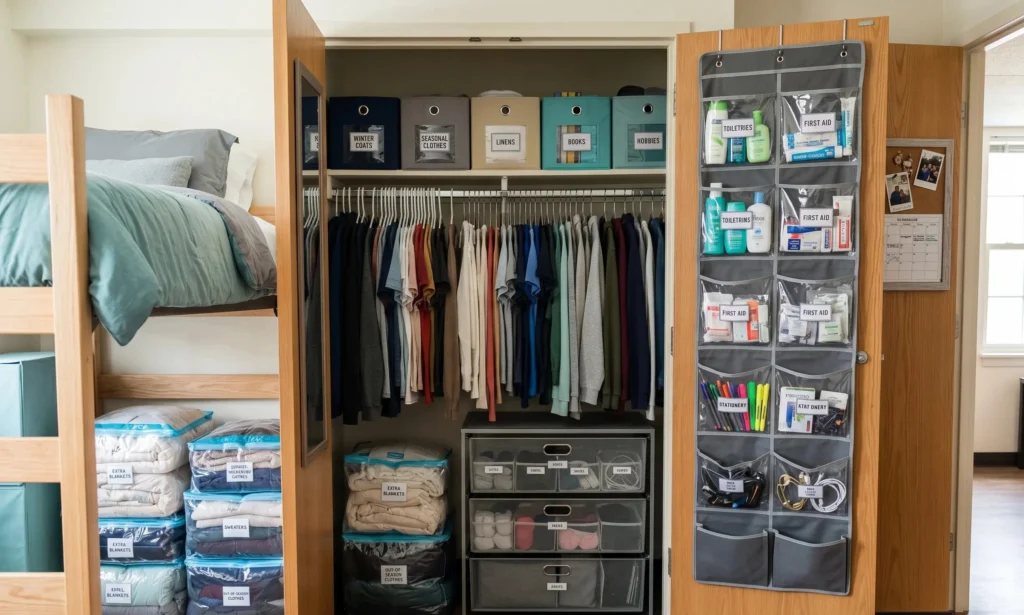
Storage in a dorm is basically a puzzle. You have almost none of it, and you’re trying to fit an entire life into about 30 square feet of personal space. Here’s the system that actually works.
Under-Bed Storage Is Prime Real Estate
If your bed isn’t lofted, get bed risers and invest in flat rolling storage bins or vacuum-seal storage bags for seasonal clothes. Under-bed storage is genuinely some of the most valuable real estate in a dorm room. I kept extra bedding, winter gear, and rarely-needed items in vacuum bags under my bed — they compress to almost nothing.
Over-the-Door Organizers
An over-door shoe organizer ($12 at Target or IKEA) is one of the most versatile things you can own in a dorm. Use it for shoes, toiletries, snacks, school supplies — anything small that ends up on your desk or floor. One goes on my closet door for clothing accessories, and another goes on the back of the bathroom door for toiletries.
The IKEA ALEX or SKADIS System
If you want to get organized properly, IKEA’s ALEX drawer unit ($130) fits under most desk setups and gives you real drawer storage. Their SKADIS pegboard ($30) is perfect for hanging supplies, headphones, cables, and small items on the wall next to your desk. Both are lightweight enough to transport in a car.
Command Hook Empire
3M Command hooks are the unsung heroes of dorm living. Hang bags, jackets, cables, headphones, even a small mirror. Get a variety pack with different weight ratings. The key is not to overload them — check the weight limit on the package and stay under it.
- Stackable clear shoe boxes — for organized closet storage
- Drawer dividers — for sock/underwear chaos control
- Hanging closet organizer — adds 5+ extra shelves vertically
- Over-door clear pocket organizer (2 pack from IKEA)
- Vacuum storage bags — for seasonal clothing
- Rolling storage cart (like IKEA RÅSKOG) — for between desk and bed
- Fabric storage cubes — for the shelf above your closet rod
7. Making It Feel Like Home (Without Losing Your Security Deposit)
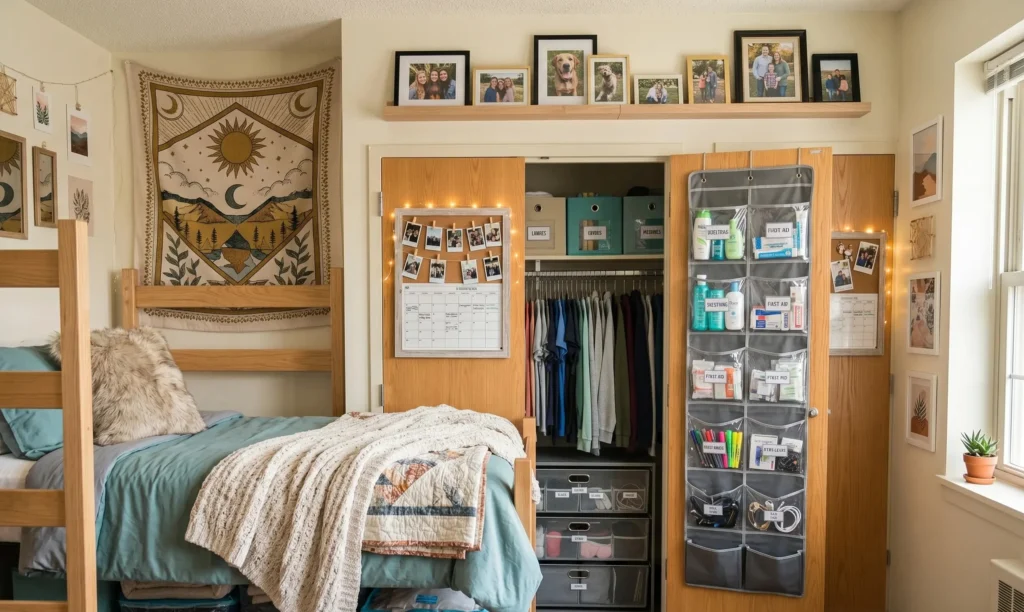
Here’s where most setup guides stop being useful — they tell you to “add some personality” without telling you how to do it without destroying your walls or spending $500 on decor.
Tapestries Are Your Best Friend
A large fabric tapestry ($15–30 on Amazon or Society6) can cover an entire wall and immediately transforms the vibe of a room. They’re hung with command strips or pushpins (check your housing rules), they’re lightweight, and they pack flat when it’s time to move out. I had a dark forest tapestry freshman year that made my side of the room look incredible and cost $20.
Polaroid or Print Photo Wall
Printing 4×6 photos at a Walgreens or CVS costs about 15–25 cents each. Arrange them on your wall using washi tape or Command mini clips. This is one of the cheapest, most personal ways to make a dorm room feel lived-in and warm. Add string lights around the arrangement and it looks genuinely beautiful.
Plants (Even Fake Ones)
A real succulent or pothos plant adds life to a dorm room. Pothos is basically indestructible — it grows in low light, forgives neglect, and costs $5 at most grocery stores. If you truly cannot keep a plant alive (no judgment), a high-quality faux plant in a nice pot looks just as good from a distance.
A Rug Ties the Room Together
Dorm floors are usually cold, ugly tile or thin industrial carpet. A 5×7 rug from IKEA, Target, or Amazon ($30–80) makes the room feel warmer and more like a real space. Get something with some texture — a flat shag or a simple geometric pattern. It also helps with noise if you’re on a hard floor.
8. Study Zone vs. Chill Zone — Yes, You Need Both
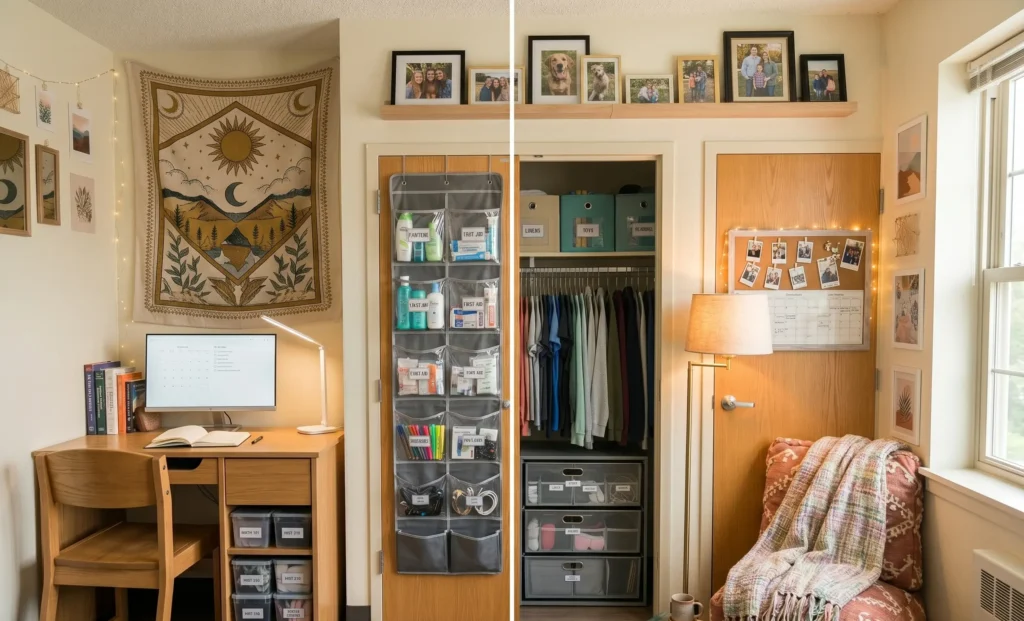
This is something I didn’t figure out until halfway through sophomore year, and it genuinely changed how I studied. In a small dorm room, your brain associates spaces with activities. If you study in your bed, your brain starts thinking of your bed as a study area — which means it stops associating your bed with sleep. And then sleep becomes hard.
The Two-Zone Rule
Even in a tiny room, create two distinct zones: one for work and one for rest. Your desk is for studying, working, and being productive. Your bed area is for reading, relaxing, and sleeping. Keep them separate in terms of where you keep things and what activities you do there.
Set Up Your Desk Properly
Your desk setup for a dorm room should include: monitor at eye level (so you’re not hunching), keyboard and mouse at a comfortable height, good lighting to your left if you’re right-handed (to avoid shadows), and no distracting clutter within arm’s reach.
Apps like Forest (iOS/Android) block distracting websites and apps during study sessions. Notion or Obsidian are great for note-taking and organizing. A physical whiteboard or corkboard above the desk keeps deadlines visible.
Create a Chill Corner
If you have space under your lofted bed, throw a floor cushion or small bean bag in there with a warm light. That becomes your “off” zone — somewhere that isn’t your bed but also isn’t your desk. It’s a small thing that helps your brain switch between productive mode and rest mode.
9. Biggest Dorm Room Setup Mistakes (I Made Them So You Don’t Have To)
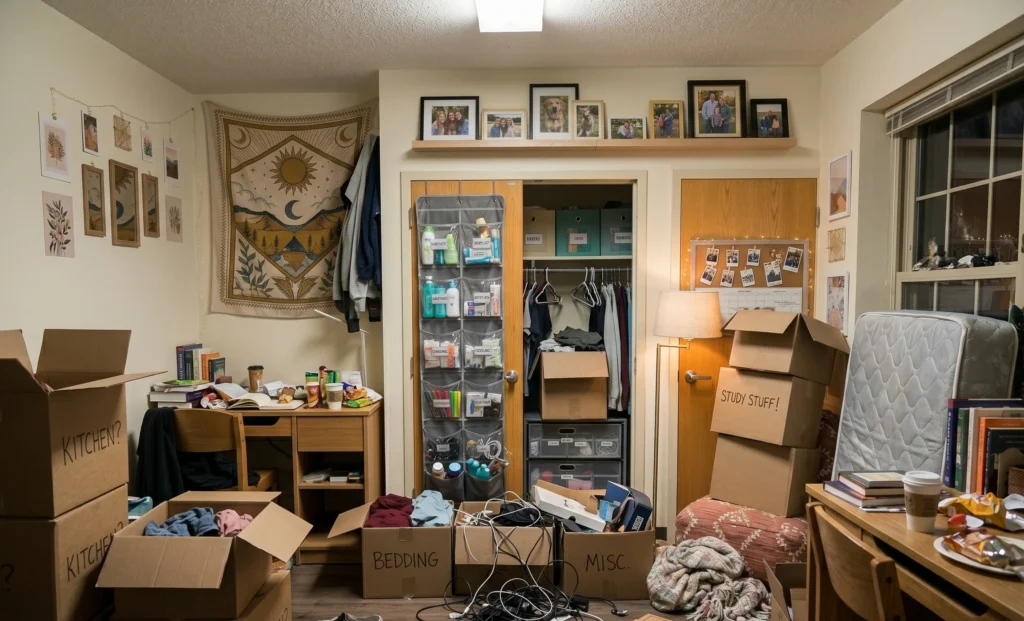
Let me save you some pain. These are the actual mistakes I made or watched other students make — and what to do instead.
Mistake 1: Buying Everything New Before You Arrive
I showed up freshman year with brand-new everything and quickly realized I’d bought the wrong sizes, the wrong colors, and items I didn’t actually need. Buy the basics first, live in the room for a week, then fill in the gaps. You’ll know exactly what you actually need versus what seemed useful in a Target aisle.
Mistake 2: Ignoring Vertical Space
Floor space is precious. Vertical space is mostly ignored. Floating shelves, over-door organizers, pegboards, tall bookshelves, and hanging organizers use the walls and doors — which are abundant even in tiny dorms. Think up, not out.
Mistake 3: One Overhead Light and Nothing Else
As covered in the lighting section — relying on the single dorm overhead light is a miserable experience. Layer your lighting. It costs maybe $50 in total and completely changes how the room feels.
Mistake 4: Not Thinking About Cable Management
Tangled cables are both ugly and a genuine hazard in small spaces. Buy a cable management tray ($12), some velcro ties ($6), and a few clip cable holders ($8) on Amazon. Spend one afternoon running cables properly. You’ll never have to deal with them again.
Mistake 5: Packing Things You Won’t Use for 4 Months
Your winter coat in September. Your snowboard gear in October. These things take up enormous amounts of space in a dorm room. Use vacuum storage bags and store seasonal items under your bed. Or ship them home with a UPS box and have them sent back when you need them.
Mistake 6: Skipping the Rug
The rug sounds optional. It’s not. Bare dorm floors are cold, echoey, and visually depressing. A rug anchors the room, adds warmth, reduces noise, and makes the space feel intentionally designed rather than randomly thrown together.
| 🚫 Don’t: Spend a ton on permanent furniture or decor in a dorm room. You’ll be moving out in 8 months. Prioritize functional, portable, lightweight items that survive multiple moves. |
10. Final Thoughts & Quick-Start Checklist
Looking back, the thing that made the biggest difference wasn’t any single product or hack — it was treating my dorm room like it actually mattered. A lot of students just tolerate their dorm room. They live in a messy, uncomfortable box and assume that’s just what college is like.
It doesn’t have to be. A great dorm room setup is achievable on a student budget, and the payoff — in terms of productivity, sleep quality, and just enjoying the space you spend half your life in — is genuinely significant.
You don’t need to do everything on this list at once. Start with the three highest-impact changes for your situation and build from there. If sleep is your issue, start with blackout curtains and better ambient lighting. If focus is the problem, fix your desk setup and add a task lamp. If the room just feels miserable, throw up a tapestry and some string lights first.
Here’s the quick-start checklist to take with you:
QUICK-START DORM ROOM SETUP CHECKLIST
- ✅ Measure the room and sketch a floor plan before arrival
- ✅ Coordinate with roommate on shared items (fridge, microwave, TV)
- ✅ Loft the bed or use bed risers for under-bed storage
- ✅ Add a floating shelf or pegboard above your desk
- ✅ Get a 24-inch external monitor and USB-C hub
- ✅ Layer your lighting: desk lamp + LED strips + accent lamp
- ✅ Install over-door organizers on both closet and bathroom doors
- ✅ Manage cables with clips, trays, and velcro ties
- ✅ Add a rug that fits your floor layout
- ✅ Personalize one wall with a tapestry or photo arrangement
- ✅ Add at least one plant (pothos for beginners)
- ✅ Keep your desk as a work-only zone, bed as a rest zone
You May Also Like These Posts
→ Brilliant Small Home Office Ideas
→ Mid Century Modern Wall Art Ideas