
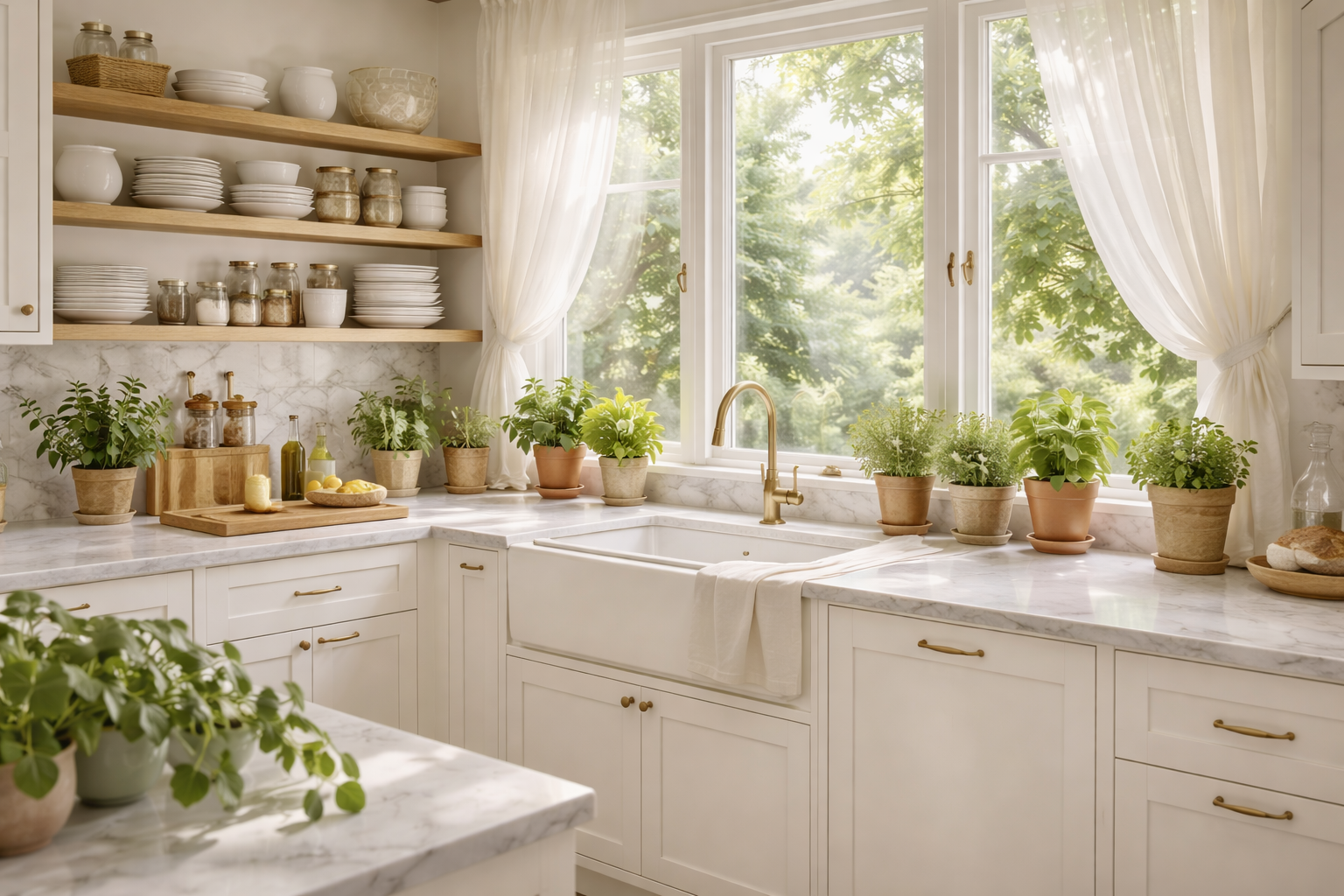
Nancy Meyers kitchen ideas are some of the most searched, most pinned, and most obsessed-over design concepts on the internet — and for very good reason.
There’s a reason people pause the movie just to stare at the kitchen.
Whether it’s Iris’s cozy Cotswold cottage in The Holiday, the sprawling Hamptons haven in Something’s Gotta Give, or the warm California family kitchen in It’s Complicated — Nancy Meyers has made kitchen design an art form. Her spaces feel lived-in yet aspirational, casual yet carefully curated. They whisper this is where life actually happens — and you desperately want to be in them.
The good news? Bringing Nancy Meyers kitchen ideas into your own home is more achievable than you think. It isn’t about spending millions. It’s about understanding her design philosophy: layers, warmth, impeccable taste, and the quiet confidence of a kitchen that has nothing to prove.
This guide breaks down exactly how to get there — one design principle at a time. Here are the 11 best Nancy Meyers kitchen ideas to transform your home.
1. Start With a Light, Airy Colour Palette
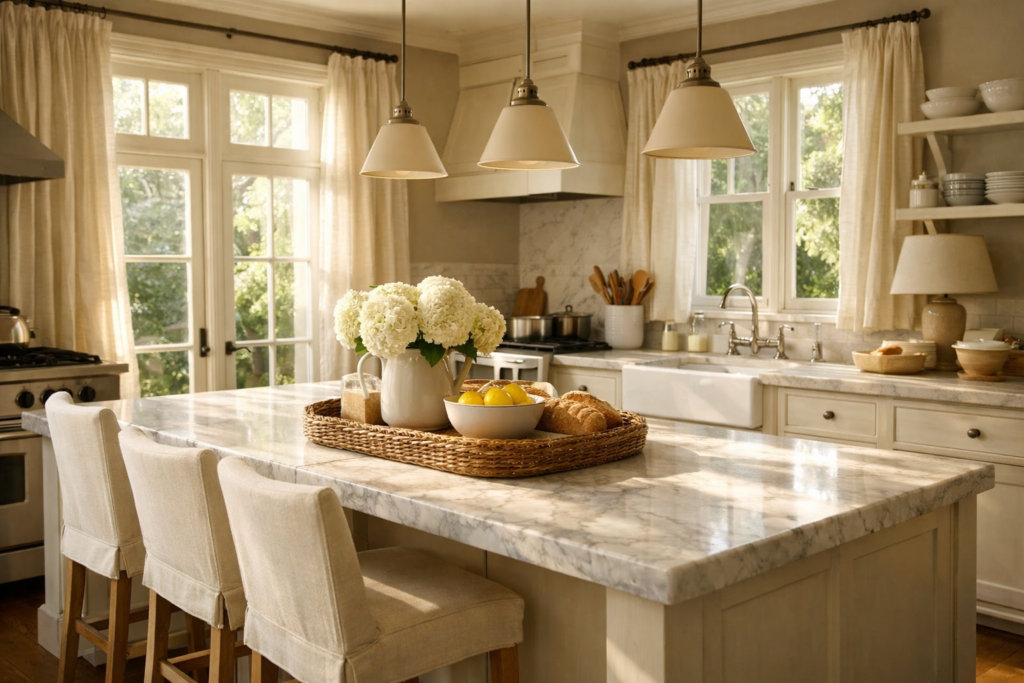
The first rule of the Nancy Meyers kitchen is this: light is the main ingredient.
Every kitchen Meyers has designed on screen — real or fictional — begins with a palette that feels washed in natural daylight even when no windows are in frame. We’re talking creamy whites, soft off-whites, warm linens, pale greiges, and the occasional whisper of sage or stone blue. Nothing jarring. Nothing that fights the light.
The key is to avoid brilliant, stark white. Instead, look for whites with warmth undertones — think Benjamin Moore’s White Dove, Farrow & Ball’s All White, or Sherwin-Williams’ Alabaster. These shades breathe warmth into a space rather than making it feel like a laboratory.
Pair your wall and cabinet colour with natural wood tones — butcher block accents, wooden bar stools, exposed timber beams if you have them. This softens the palette further and grounds the space so it never tips into cold minimalism.
Pro tip: Keep your ceiling, upper cabinets, and walls in the same pale family. It creates visual continuity that makes the kitchen feel larger and makes that golden afternoon light absolutely magical.
2. Embrace Open Shelving (Done the Nancy Meyers Way)
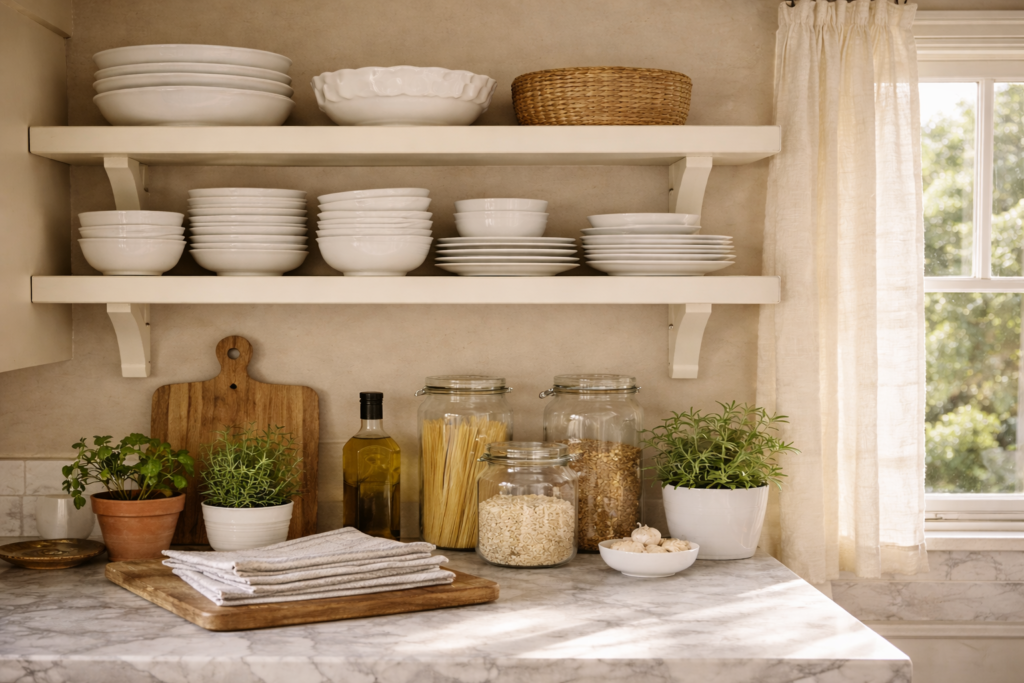
Open shelving is a polarising design choice — but in a Nancy Meyers kitchen, it’s non-negotiable. Those carefully styled shelves aren’t just storage; they’re part of the storytelling. They say: someone who really cooks lives here. Someone who loves beautiful things but isn’t precious about them.
The trick to making open shelves work is what Meyers always gets right: they look curated but never staged.
Here’s the formula:
- Stack white or cream ceramics — pitchers, bowls, plates — in relaxed groupings
- Add a few glass jars filled with pasta, grains, or dried goods
- Tuck in a small potted herb or trailing plant for life
- Leave intentional breathing room between objects — don’t overcrowd
- Mix textures: smooth glazed pottery next to rough terracotta next to worn linen
The shelves in a Nancy Meyers kitchen look like they’ve been assembled over years of living, not styled in an afternoon. That sense of accumulation and authenticity is everything.
If you’re nervous about committing to fully open shelves, start by removing the doors from a few upper cabinets. It opens up the space visually, costs almost nothing, and gives you a taste of the effect before you go all in.
3. Invest in the Countertops — They’re the Star of the Show
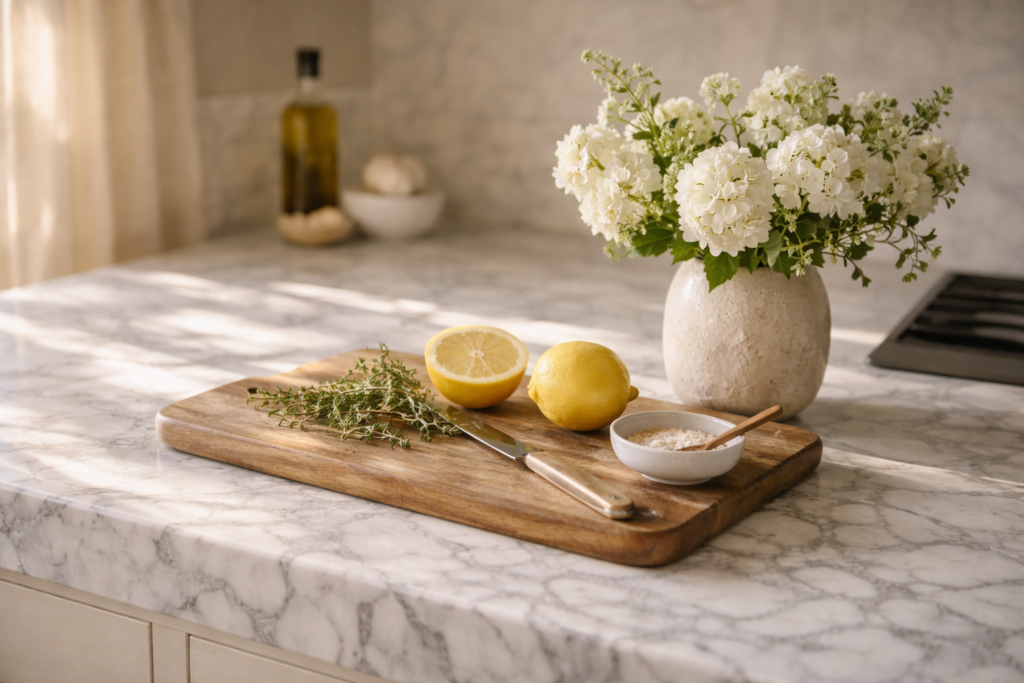
In every Nancy Meyers kitchen, the countertops are the kind of surface you want to run your hands over. They’re generous. They’re beautiful. And they’re treated not as a functional necessity but as a design statement.
Marble is the gold standard of the Meyers aesthetic — specifically, Carrara or Calacatta marble with soft grey veining on a white or cream base. It photographs beautifully, ages gracefully, and carries that European kitchen energy that runs through all her films.
That said, real marble is an investment and requires maintenance. If budget or practicality is a concern, consider:
- Quartzite — natural stone with marble-like looks but better durability
- Honed quartz in white or cream tones (matte finish is key — avoid glossy engineered stone)
- Butcher block for islands or secondary surfaces — warm, tactile, and deeply cozy
Whatever material you choose, go thick. A substantial countertop edge (1.5 to 3 inches) reads as luxury and permanence. Thin, builder-grade countertops are the single fastest way to make a kitchen feel cheap regardless of what else you’ve spent money on.
And please — no granite with busy brown swirls. The Meyers palette does not have room for it.
4. Add Farmhouse Furniture Charm
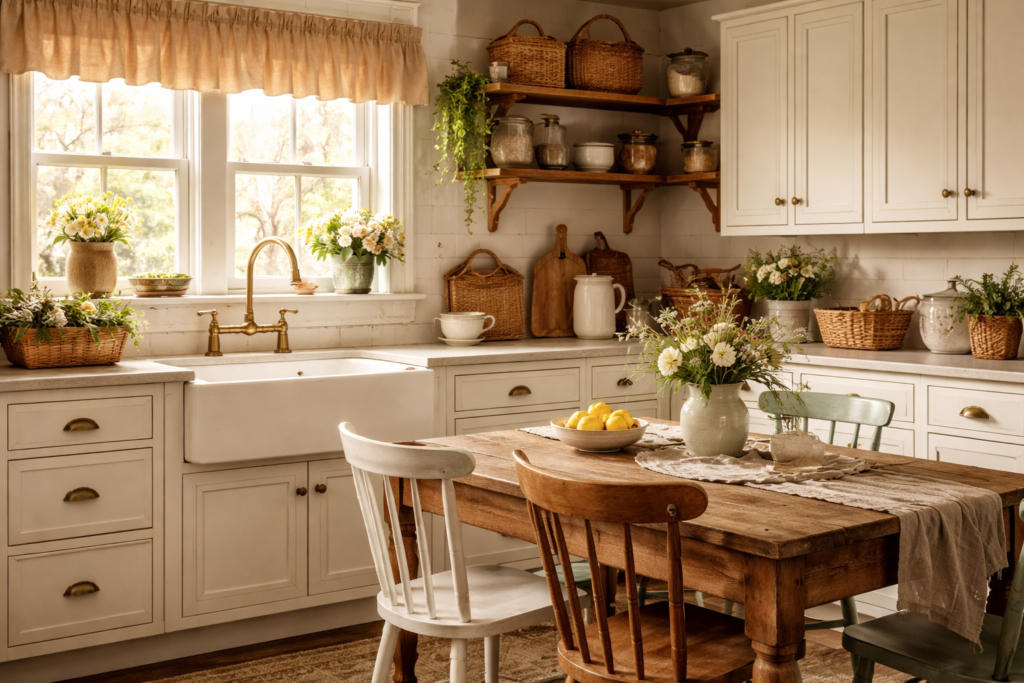
One of the most distinctive qualities of the Nancy Meyers kitchen is that it doesn’t look like a showroom. It looks like a home — one that’s been filled with furniture and objects gathered slowly, with love and intention.
The farmhouse element is central to this. But we’re not talking shiplap and mason jars. We’re talking refined farmhouse — the French countryside version, the Hamptons beach house version, the Cotswolds cottage version.
Here’s how to bring it in:
The apron-front sink is almost a Meyers signature. A wide, deep farmhouse sink — ideally in white fireclay or porcelain — is both functional and deeply charming. It anchors the kitchen and immediately communicates that this is a place where real cooking happens.
A long farmhouse table or island with turned legs rather than a cold waterfall island creates warmth and human scale. If your island can double as a dining spot, even better — this blurring of kitchen and living is quintessential Meyers.
Vintage or antique pieces — a worn wooden stool, an old French bread board propped against the backsplash, a rattan basket sitting on the counter — bring that sense of time and story that makes these spaces feel real rather than renovated.
5. Layer in Warm, Living Details
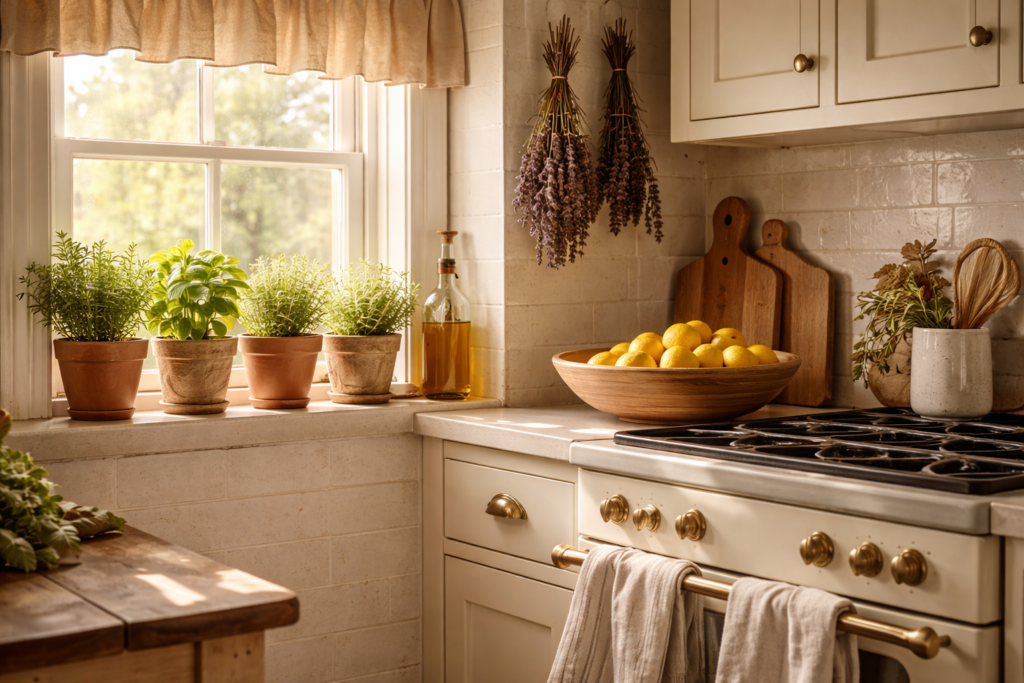
This is where the Nancy Meyers magic really happens — and it’s also the most copied, most misunderstood element of her design language.
The details in a Meyers kitchen aren’t decorative. They’re alive. They suggest that someone was just there, just cooking, just arranging flowers, just coming in from the garden.
The living layer includes:
- Fresh or dried botanicals — a bunch of eucalyptus tied with twine, a simple jar of market flowers, a terracotta pot of rosemary or thyme on the windowsill
- Food as decoration — a wooden bowl of lemons, a hanging bunch of garlic, a plate of tomatoes from the garden
- Textiles with texture — heavyweight linen tea towels, a well-worn oven glove, a loose-weave napkin draped casually
- Books and paper — a cookbook left open, a notepad by the phone, a torn recipe clipping
- The worn and imperfect — a slightly chipped mug that’s too loved to replace, a scratched cutting board that’s been through a thousand Sunday roasts
The secret is that these details feel uncontrived. They’re not arranged. They’ve just landed there. Achieving that quality takes restraint — add one or two things, step back, and resist the urge to keep adding.
6. Choose Classic, Not Trendy Hardware and Fixtures
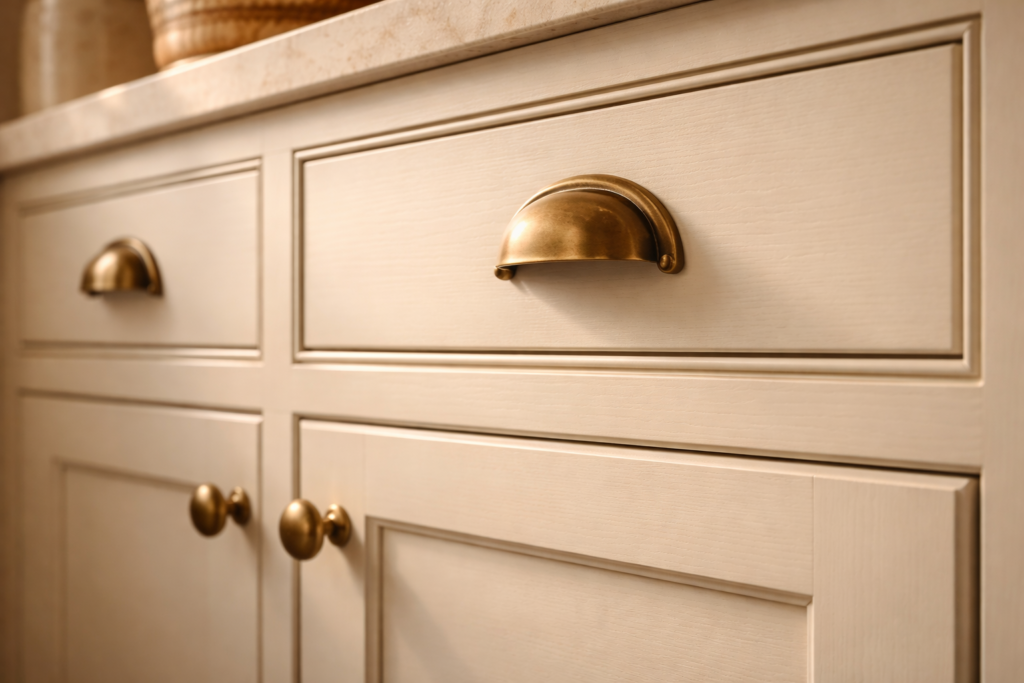
Nothing dates a kitchen faster than trend-chasing hardware. Nancy Meyers, to her credit, has always understood this. Her kitchens don’t have the hardware of the moment — they have hardware that has always been right and always will be.
The palette is simple:
- Unlacquered brass — warm, develops a patina over time, feels lived-in and authentic
- Aged bronze — rich, dark, slightly antique-feeling
- Polished nickel — cooler and more refined than chrome, pairs beautifully with marble
- Matte black — used sparingly, as an accent rather than a statement
For handles and pulls, the cup pull and the simple bin pull are deeply Meyers. Avoid bar pulls (too modern), anything too ornate (too Victorian), and anything that looks like it came from a big-box hardware store.
For faucets, a bridge-style or gooseneck faucet in brass or nickel over a farmhouse sink is the single most transformative upgrade you can make. It doesn’t just look beautiful — it immediately gives your kitchen a sense of character and permanence.
The rule: if a piece of hardware looks like it couldn’t have existed before 2015, it probably doesn’t belong in this kitchen.
7. Create Seating That Actually Feels Inviting
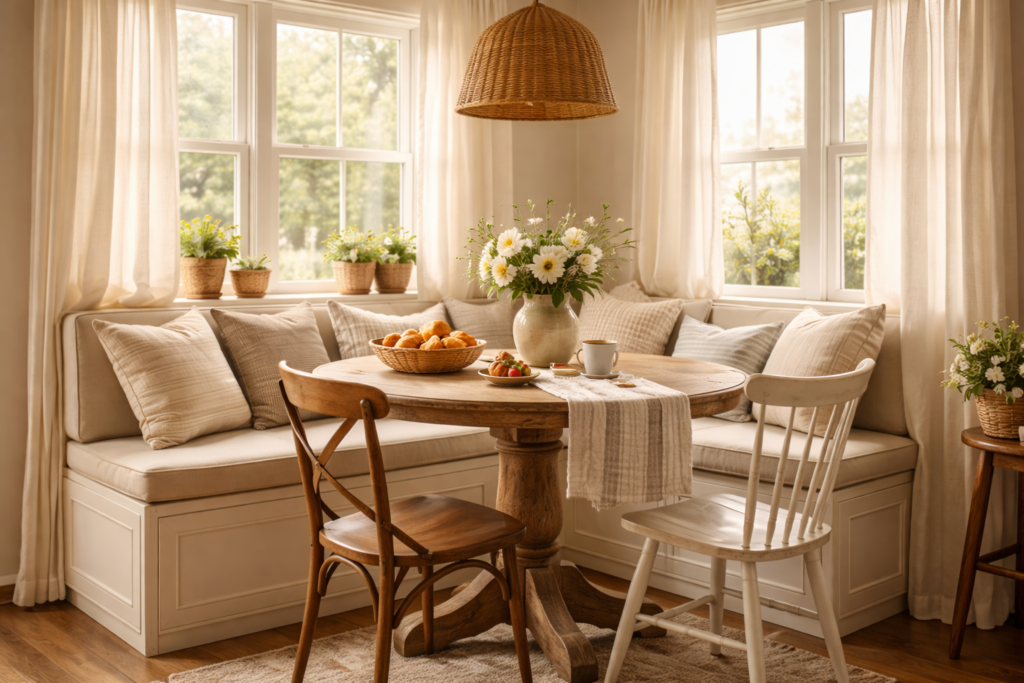
A kitchen without a place to sit and linger is just a food preparation facility. Nancy Meyers would never allow it.
Every great Meyers kitchen has a seating moment — somewhere that pulls you in, makes you want to pour a second glass of wine, encourages the kind of long conversations that only happen in kitchens.
Options to consider:
A breakfast banquette is the ultimate Meyers move — a built-in bench seat, ideally tucked into a corner or bay window, upholstered in a forgiving, washable fabric like heavy linen or cotton canvas. Add a round or oval table (not a rectangle — too formal) and mismatched chairs for that collected-over-time feel.
Comfortable bar stools at an island — but the right kind. Not backless industrial stools. Instead: low-back wooden stools, counter-height chairs with a slight curve, or cane-seat stools with a turned leg. The seating should feel like furniture, not gym equipment.
An armchair or small sofa nearby if your kitchen opens into a living space. Meyers loves the blurring of room categories. A comfortable reading chair near the kitchen means the kitchen becomes the centre of the home — which is exactly what it should be.
Avoid: hard, uncomfortable stools that scream “you’re welcome to sit but not for long.” The invitation should be genuine.
8. Get the Lighting Right — It Changes Everything
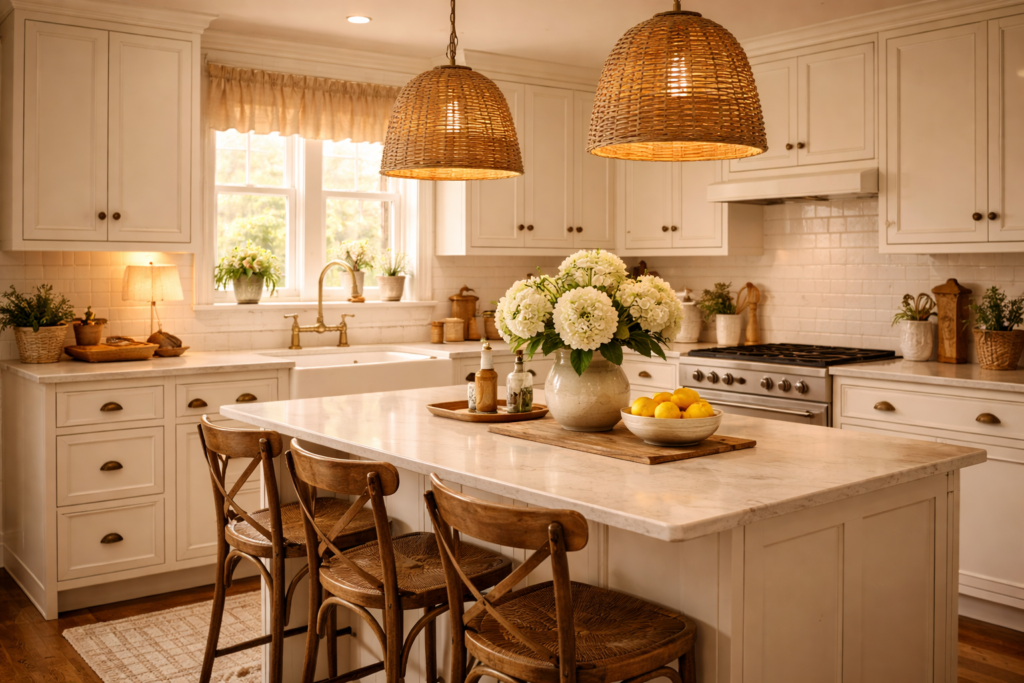
You could have the most beautifully designed kitchen in the world, and poor lighting would ruin it. Nancy Meyers knows this. Her cinematographers know this. And great interior designers know this.
The lighting in a Meyers kitchen is warm, layered, and human. It mimics natural light — golden, low, soft. Here’s how to build it:
Warm-toned bulbs across the board. A colour temperature of 2700K to 3000K is your sweet spot. Anything cooler moves into office territory. Anything warmer tips into candlelight. 2700–3000K is the range where food looks beautiful, skin looks good, and everything feels like early evening in Provence.
Statement pendant lights over the island. A single pendant or a run of two or three pendants in aged brass, rattan, or ceramic adds personality and brings the light source down to a human level. Look for pendants with a dome or cage shape — not the industrial Edison bulb on a wire, which has been thoroughly overdone.
Under-cabinet lighting. This is the detail that separates a well-designed kitchen from a great one. Warm LED strip lighting under your upper cabinets illuminates the countertop beautifully and creates depth in the space.
Dimmers on everything. The ability to shift from bright cooking light to ambient evening glow is what makes a kitchen feel truly livable.
9. Think About Cabinetry as Architecture
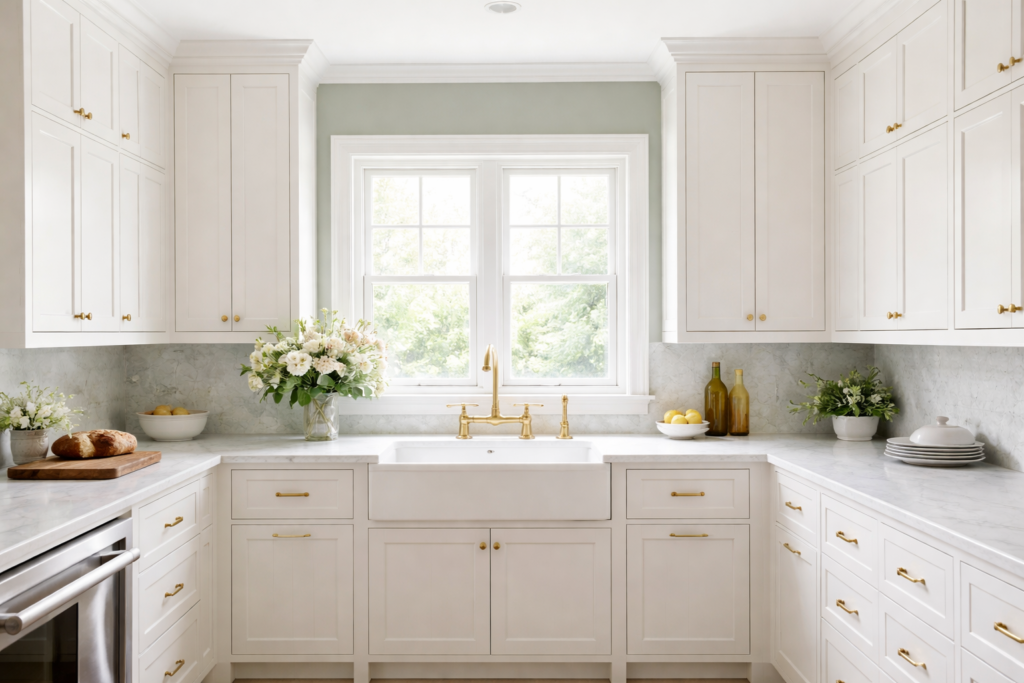
In a Nancy Meyers kitchen, the cabinetry isn’t just storage with doors. It is the architecture of the room. It is what gives the kitchen its character, its weight, its sense of permanence.
The shaker cabinet is the undisputed king of the Meyers aesthetic. Simple inset frame with a flat recessed panel — it has been in style for over two hundred years and will continue to be for another two hundred. It works with everything. It photographs beautifully. It never looks cheap if executed well.
What elevates shaker cabinets from builder-grade to Meyers-grade:
- Inset construction rather than overlay — the door sits flush inside the frame, which creates a more refined, furniture-like appearance
- Depth and height — floor-to-ceiling cabinetry where possible creates a sense of grandeur even in a small kitchen
- A mix of open and closed — see tip #2 on open shelving; this combination is more interesting than all-one-or-the-other
- Paint quality — a beautifully hand-painted cabinet in a properly mixed white feels completely different from a factory spray in a similar colour
Consider unfitted kitchen elements — a freestanding hutch, a vintage dresser repurposed as lower cabinetry, a standalone island that looks like a piece of furniture rather than a built-in unit. This unfitted approach is central to the Meyers look and works particularly well in older homes or cottages.
10. Bring the Outside In With Windows, Plants, and Garden Views
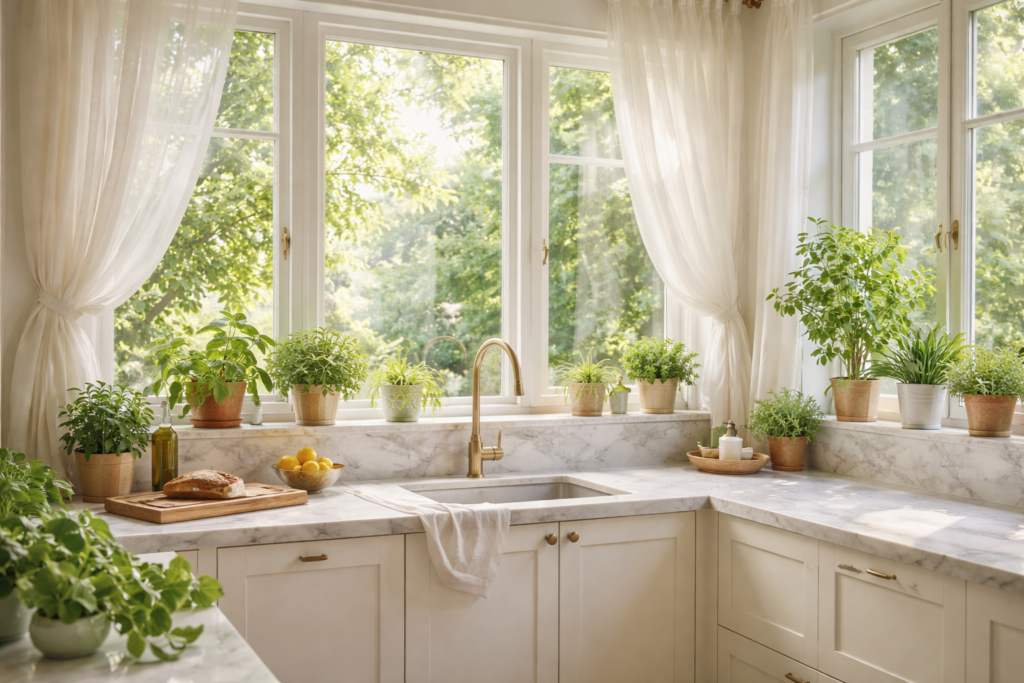
In almost every Nancy Meyers film, the kitchen has a strong relationship with the outdoors. Big windows. A view of a garden. French doors that open onto a terrace. This connection to the natural world is fundamental to why these spaces feel so alive.
If you have windows, honour them. Keep them as clear as possible — no heavy curtains that block the light. If you want window treatments, use sheer linen panels that filter the light rather than blocking it, or simple Roman shades that can be pulled fully up during the day.
If you don’t have much window space, compensate with plants. A trailing pothos or ivy on a high shelf, a fiddle-leaf fig in a corner, pots of herbs lined up on the windowsill — these bring organic life and colour without requiring a garden view.
The idea is simple: the Meyers kitchen is not sealed off from nature. It breathes. It changes with the seasons. That quality of aliveness is part of what makes it feel so inviting.
11. Honour Imperfection and Patina
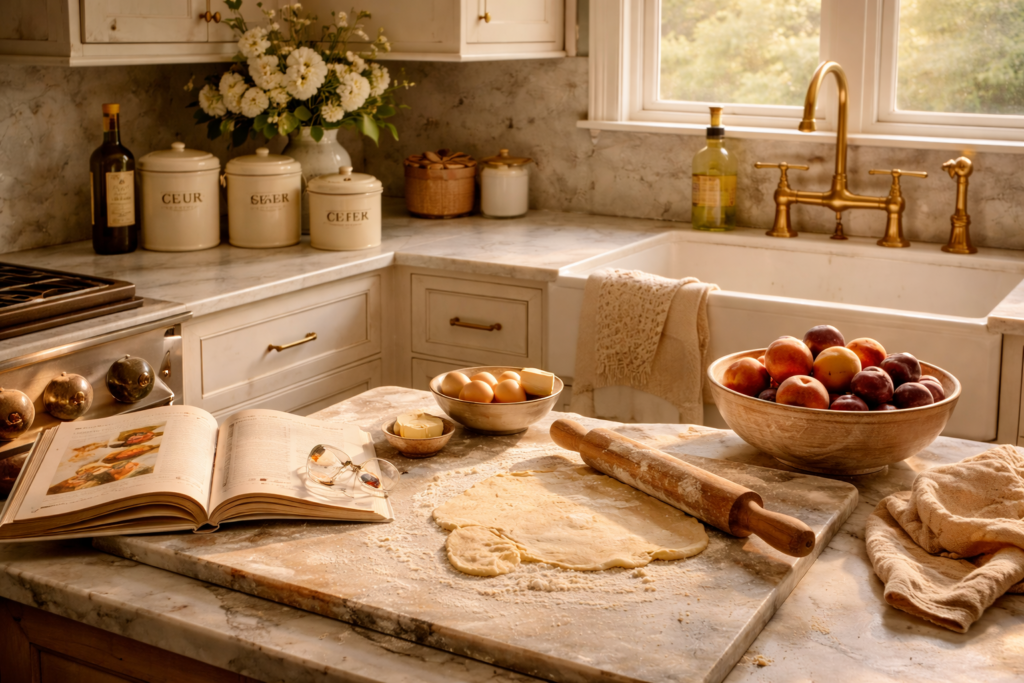
One of the most counterintuitive elements of the Nancy Meyers aesthetic is this: perfection would ruin it.
The most copied mistake people make when trying to recreate her look is that they get everything too new, too matching, too pristine. They buy the full set rather than collecting individual pieces. They replace the worn thing instead of celebrating it.
The Nancy Meyers kitchen has patina. The marble has a ring stain from years of mornings. The brass is slightly green in the corners. The wooden table has scratches. The mixing bowls are slightly mismatched. This isn’t neglect — it’s evidence of a life being lived.
Practically, this means:
- Choosing unlacquered brass that will age and develop character over time
- Buying antique or vintage pieces rather than new reproductions where possible
- Not replacing worn wooden items that still function well
- Embracing the inevitable wear on natural surfaces like marble and butcher block
- Shopping vintage markets and estate sales for ceramics, cookware, and accessories
The goal is a kitchen that looks like it has been lived in for decades — even if it was renovated last year.
Final Thought: The Nancy Meyers Kitchen Is a Feeling, Not a Formula
You can follow every tip in this guide and still miss what makes a Nancy Meyers kitchen so irresistible if you forget the most important principle: these kitchens are designed for living, not for looking at.
The marble is there to be used. The open shelves are there to be reached into. The farmhouse table is there to be gathered around at 11pm when nobody wants to leave. The worn cutting board has been worn by years of Sunday morning cooking. The herbs on the windowsill are there to be pinched off and thrown into whatever is on the stove.
The greatest thing Nancy Meyers has ever designed is not a kitchen — it’s the feeling of being in one. Of being somewhere beautiful and comfortable and real. Of being in a place where life is, as they say in the films, complicated and wonderful and worth savouring.
That’s what you’re really building. And it starts, as all great things do, with the right shade of white.
You May Also Like These Posts
- 15+ Stunning Easter Nail Ideas for 2026
- Trendy & Cute Vacation Nail Ideas 2026
- Cute Half Up Half Down Hairstyles 2026
- 2026 Kitchen Trends
Frequently Asked Questions About Nancy Meyers Kitchens
What makes a Nancy Meyers kitchen different from a regular white kitchen?
It’s the layering and intentionality. A Nancy Meyers kitchen isn’t just white — it’s warm, textured, and full of carefully selected details that suggest a life being lived there. The combination of natural materials, classic architecture, vintage accessories, and that particular quality of light all work together to create something that feels far more emotionally resonant than a standard white kitchen.
What colour white does Nancy Meyers use in her kitchens?
While the specific paint colours vary by project, the aesthetic consistently gravitates toward warm whites and off-whites with cream or yellow undertones rather than bright, cool whites. Benjamin Moore White Dove, Farrow & Ball All White, and Sherwin-Williams Alabaster are popular real-world equivalents that capture the warmth of the Meyers palette.
How much does it cost to get a Nancy Meyers kitchen look?
You can apply the principles at any budget. The look is more about philosophy than price point — choosing classic over trendy, natural over synthetic, layered over sparse. A modest refresh with new hardware, open shelving, and carefully chosen accessories can dramatically shift the feel of a kitchen without a full renovation.
Is marble practical for a kitchen?
Marble requires more maintenance than engineered stone — it can stain and etch with acidic substances like lemon juice and wine. However, many designers argue that the patina marble develops over time only adds to its beauty. If you want the look without the maintenance, honed quartzite or high-quality matte quartz in white tones are excellent alternatives.
Can I get the Nancy Meyers look in a small kitchen?
Absolutely. In fact, some of the cosiest Meyers-inspired spaces are compact. A small kitchen benefits enormously from the light palette (it visually expands the space), strategic open shelving (removes the visual weight of upper cabinets), good lighting, and thoughtful detail work. Scale your choices — a single pendant instead of three, one statement plant instead of several — but the principles translate perfectly.
What type of flooring works best for this kitchen style?
Wide-plank hardwood in a warm, natural tone is the ideal. Look for lighter, honey-toned woods — white oak is a current favourite. For a more rustic or cottage feel, reclaimed wood adds instant character. Stone or large-format tile in a warm cream or terracotta also works beautifully. Avoid dark hardwood (too heavy), grey-toned wood (too trendy), and any tile with a glossy finish.
What kitchen appliances fit the Nancy Meyers aesthetic?
Professional-style ranges in white enamel or stainless steel — AGA, La Cornue, or Bertazzoni are the dream choices. For a more accessible option, the SMEG range in white or cream captures the retro-professional aesthetic beautifully. Panel-ready dishwashers and refrigerators (where the front takes a cabinet panel) keep the kitchen looking furniture-like rather than appliance-forward.