
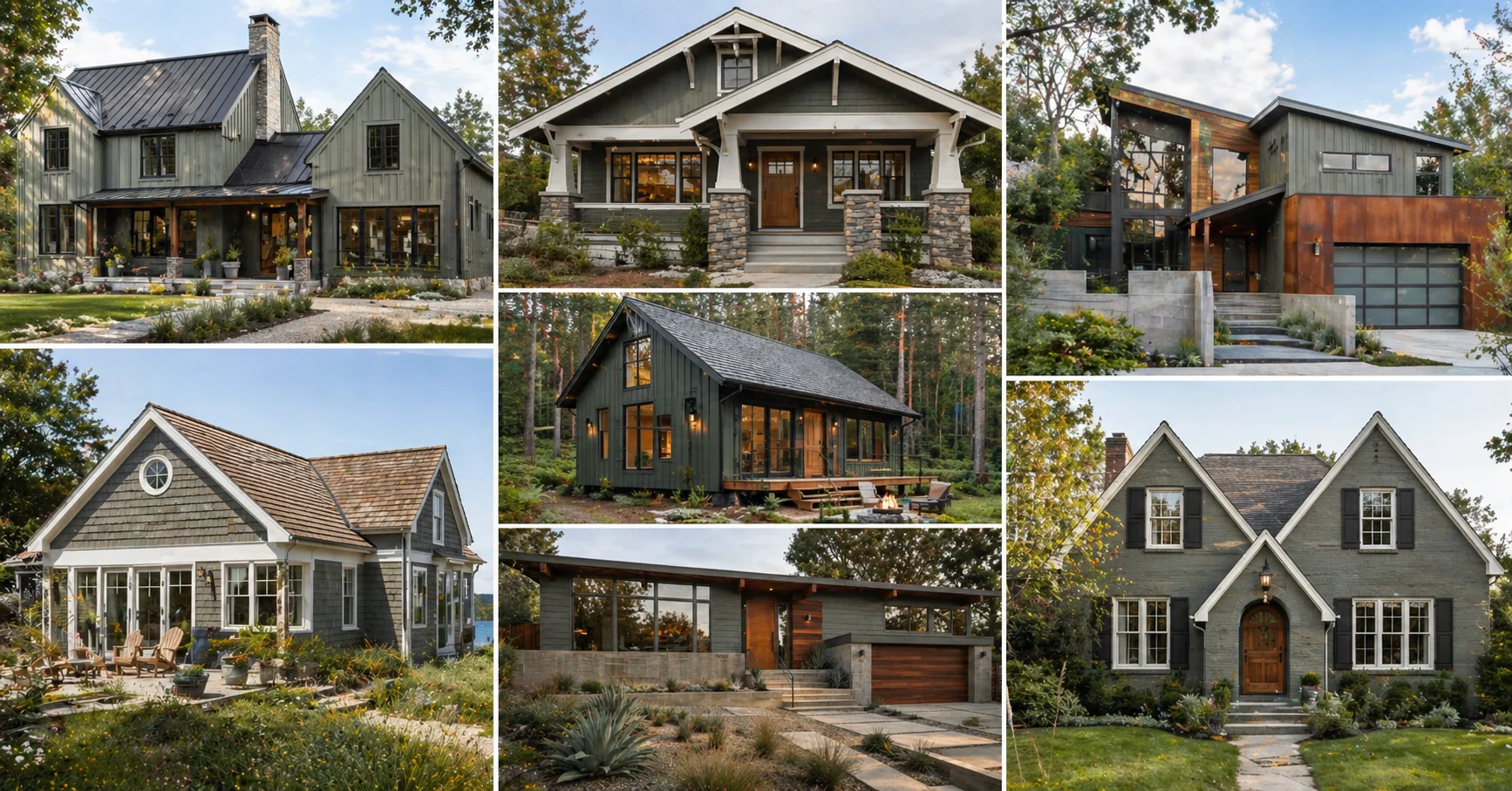
Pewter green house ideas are taking over curb appeal conversations — and for good reason. This sophisticated, nature-inspired shade sits at the perfect crossroads between forest green and warm gray, giving your home an exterior that feels grounded, modern, and utterly timeless all at once.
If you have been searching for a color that works across multiple architectural styles, complements almost every trim color, and photographs beautifully in every season, pewter green may be the answer you have been looking for. Unlike trendy shades that fade quickly from fashion, pewter green carries an enduring quality rooted in nature itself.
In this guide, you will find 7 distinct pewter green house ideas — each with specific design pairings, AI image prompts you can use to visualize the look, and expert tips to help you execute the style flawlessly. Whether you are planning a full exterior repaint, choosing new siding, or simply refreshing your shutters and front door, there is a pewter green approach that fits your home perfectly.
What Makes Pewter Green the Perfect Exterior House Color?
Before diving into the specific pewter green house ideas, it helps to understand what makes this shade so versatile. Pewter green sits in a unique color family — it is not a bright, saturated forest green, nor a muted sage, nor a cool blue-green. Instead, it blends:
- Deep, warm green undertones for a connection to nature
- Cool gray undertones for sophistication and versatility
- Medium-to-dark depth for visual presence without being aggressive
- Chameleon-like behavior in different lighting — appearing more green at midday, more gray at dusk
The most popular pewter green paint options in 2026 include Sherwin-Williams’ SW 6208 Pewter Green, Benjamin Moore’s HC-134 Tarrytown Green, and Farrow & Ball’s Mizzle. Each has slightly different undertones, so always sample on your actual exterior before committing.
What truly sets pewter green apart from other exterior greens is its compatibility. It pairs naturally with white, cream, black, charcoal, warm wood tones, natural stone, brick, steel, and cedar — making it one of the most design-flexible exterior colors available.
Idea 1: The Modern Farmhouse with Pewter Green Siding
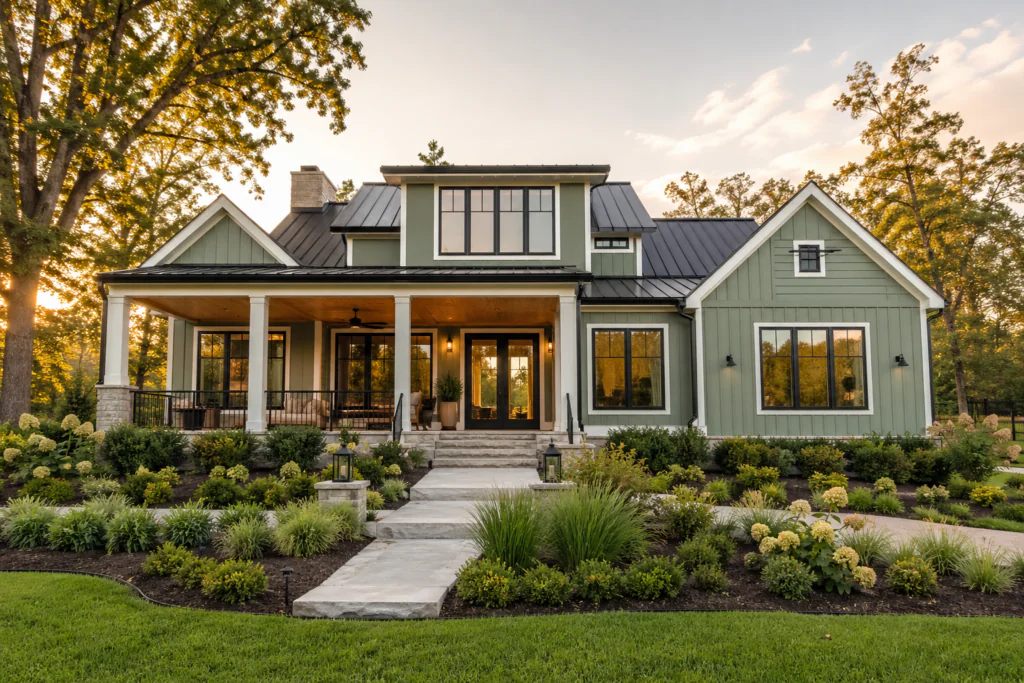
The modern farmhouse style has evolved dramatically in recent years — and pewter green siding is leading that evolution. Where white once reigned supreme, homeowners today are choosing richer, more connected colors that tell a story about the land and nature surrounding the home.
Pewter green siding on a modern farmhouse creates an organic, earthy feel that feels both current and rooted. The key is pairing it correctly:
Best Pairings for a Pewter Green Modern Farmhouse
- Trim: Bright white or warm cream for maximum contrast
- Roof: Matte black or dark charcoal standing-seam metal roof
- Windows: Black-framed casement or double-hung windows
- Accents: Warm cedar or reclaimed wood porch ceiling, beams, and shutters
- Hardware: Matte black door handles, light fixtures, and house numbers
- Foundation: Board-formed concrete or natural fieldstone
One design move that elevates a pewter green farmhouse above the ordinary is vertical board-and-batten siding. The verticality draws the eye upward, making even a single-story home feel taller and more imposing. For two-story homes, consider using pewter green board-and-batten on the upper level and a lighter shade of the same hue — or natural shiplap — on the lower section for subtle contrast.
Landscaping to Complement Pewter Green Farmhouse Exteriors
The landscaping around a pewter green modern farmhouse should feel intentional but relaxed. Consider native grasses, ornamental shrubs with burgundy or bronze foliage, climbing hydrangeas trained up porch posts, and mature shade trees. Black metal planters at the entry filled with seasonal flowers add a polished touch without interrupting the organic feel.
Idea 2: Craftsman Character — Pewter Green with Natural Stone
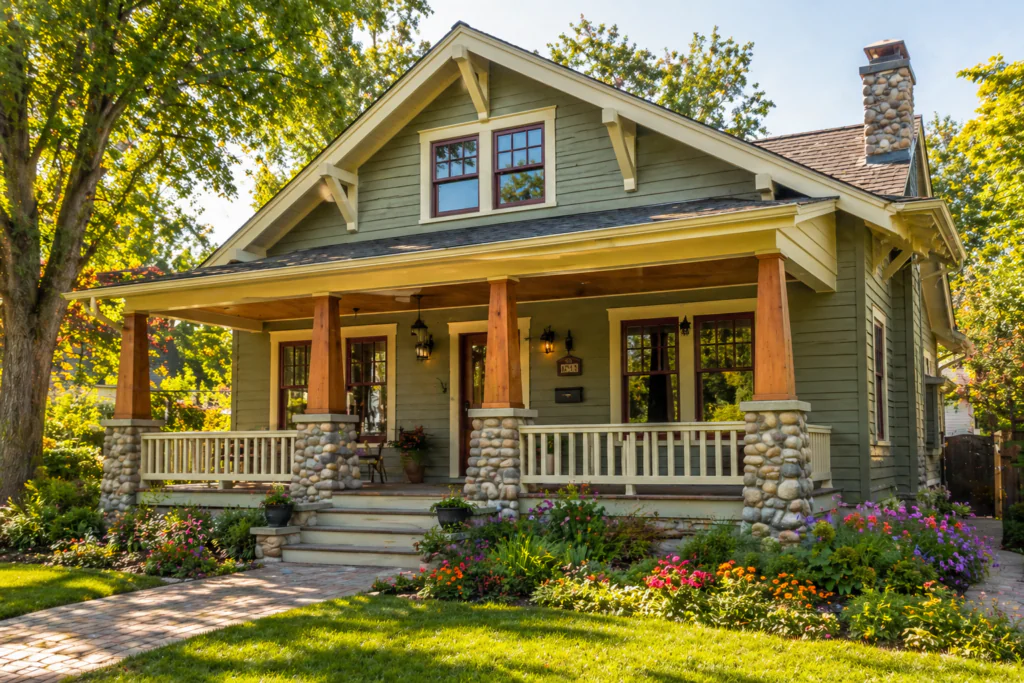
Craftsman homes are known for their attention to material detail — natural wood, handcrafted joinery, and earthy stone. Pewter green slots into this tradition beautifully, connecting the home to its landscape while highlighting the craftsmanship inherent in the architecture.
The magic happens when you layer three key elements together: pewter green siding, natural stone accents, and warm cream or ivory trim. Each element plays a distinct role:
- Pewter green siding: The grounding foundation that reads as natural and calm
- Natural stone (fieldstone, river rock, or stacked slate): Adds texture, weight, and permanence around porch columns, foundations, and chimneys
- Cream or ivory trim: Frames architectural details — window casings, corner boards, exposed rafter tails — without competing with the stone
The gray undertones in pewter green sync naturally with the cool and warm mineral tones found in most natural stone, creating a cohesive palette that feels as though the home grew from the earth beneath it.
Where to Add Stone Accents on a Pewter Green Craftsman Home
- Wrap porch column bases in stacked stone up to the mid-point, then transition to painted wood tapers above
- Use stone on the first 24-36 inches of the foundation for a grounded, anchored appearance
- Add a stone chimney that carries the same material language from ground to roofline
- Install stone entry steps and landing for durability and visual continuity
For the front door, consider a deep burgundy, navy, or even a warm terracotta — all of which sing against a pewter green backdrop while nodding to the Craftsman tradition of rich, saturated accent colors.
Idea 3: Contemporary Wood and Steel — A Bold Modern Statement
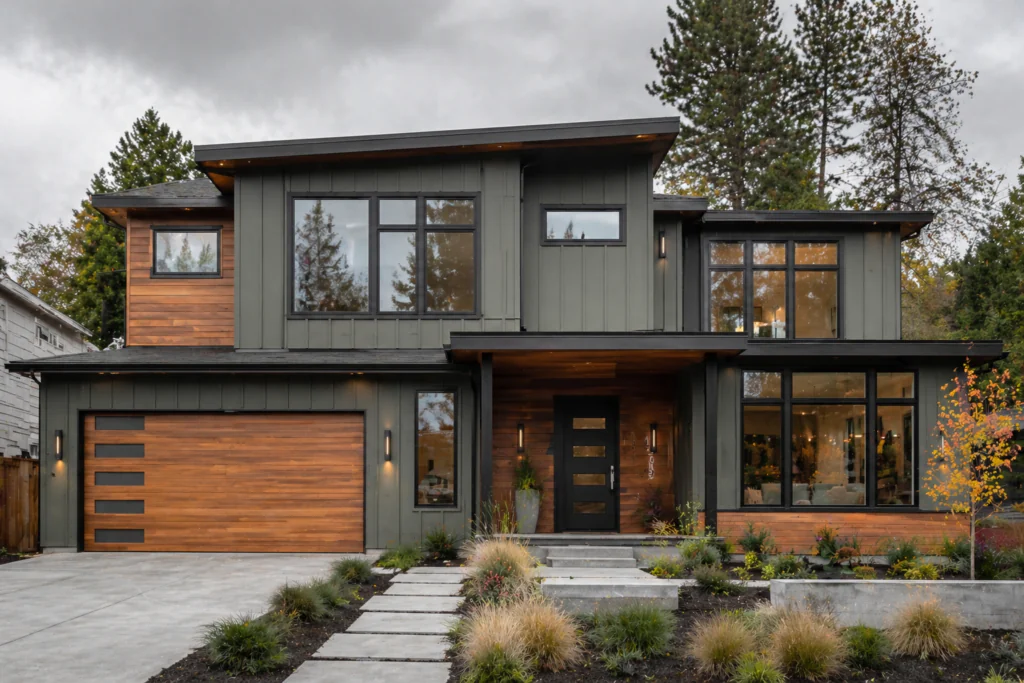
For homeowners who want a more cutting-edge look, the combination of pewter green vertical siding with warm cedar wood and matte black steel creates a contemporary exterior that is sophisticated without being cold or industrial.
This three-material approach works because each element contributes something distinct:
| Material | Role | Best Application |
| Pewter Green Siding | Primary color field, visual anchor | Full facade or upper panels |
| Warm Cedar Wood | Adds organic warmth, softens the palette | Entry surround, accent walls, fascia |
| Matte Black Steel | Sharpens lines, adds modern edge | Window frames, railings, door |
| Concrete or Gravel | Grounds the design, modern texture | Pathways, steps, driveway |
The key design principle here is intentional contrast. The warmth of cedar prevents the pewter green and black steel from feeling too stark or office-like. The black frames add precision that stops the cedar from feeling rustic or casual. And the pewter green unifies it all with a natural, calming presence.
Tips for Getting the Contemporary Wood and Steel Look Right
- Choose vertical siding orientation for pewter green panels — it creates height and visual interest
- Install cedar horizontally to contrast the vertical green panels — the perpendicular lines add tension
- Use matte finishes on all black steel elements — glossy black can look cheap at scale
- Keep landscaping minimal and architectural — ornamental grasses, concrete planters, and river rock
- Coordinate your garage door: a cedar-look composite or matte black steel door completes the look
Idea 4: Traditional Brick and Gable — Timeless Curb Appeal
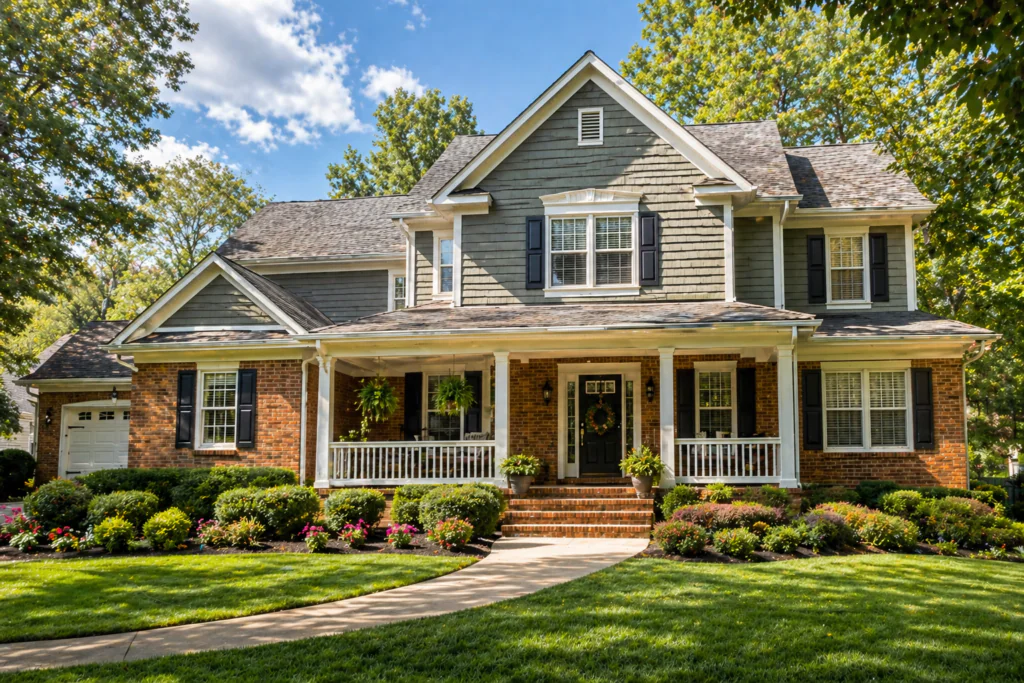
One of the most elegant pewter green house ideas involves pairing this cool gray-green with warm red brick. The contrast between brick’s earthy warmth and pewter green’s cool composure creates a balanced, sophisticated exterior that feels both traditional and updated.
The formula is straightforward: brick handles the structural lower level, pewter green siding takes the upper gables and dormer sections, and white or cream trim connects the two. Here is why this works so well:
- Red brick introduces warmth that prevents pewter green from reading cold in shade
- Pewter green lightens the visual weight of heavy brick massing above the ground level
- White trim creates clear definition between the two materials
- The combination reads as established and traditional — perfect for neighborhoods with classic architecture
Variations on the Brick and Pewter Green Theme
If your home does not have red brick, this same concept works beautifully with light tan brick, warm gray limestone, or painted brick in a cream or warm white. Slightly lighter brick allows the pewter green to command more visual attention, creating a more contemporary feel within a traditional framework.
For shutters, choose either classic black for a crisp, formal look or deep forest green (slightly darker than your siding) for a tonal, layered effect. Both approaches work — the choice depends on whether you want contrast or cohesion to lead the design.
Idea 5: Scandinavian Forest Cabin — Minimal and Magical
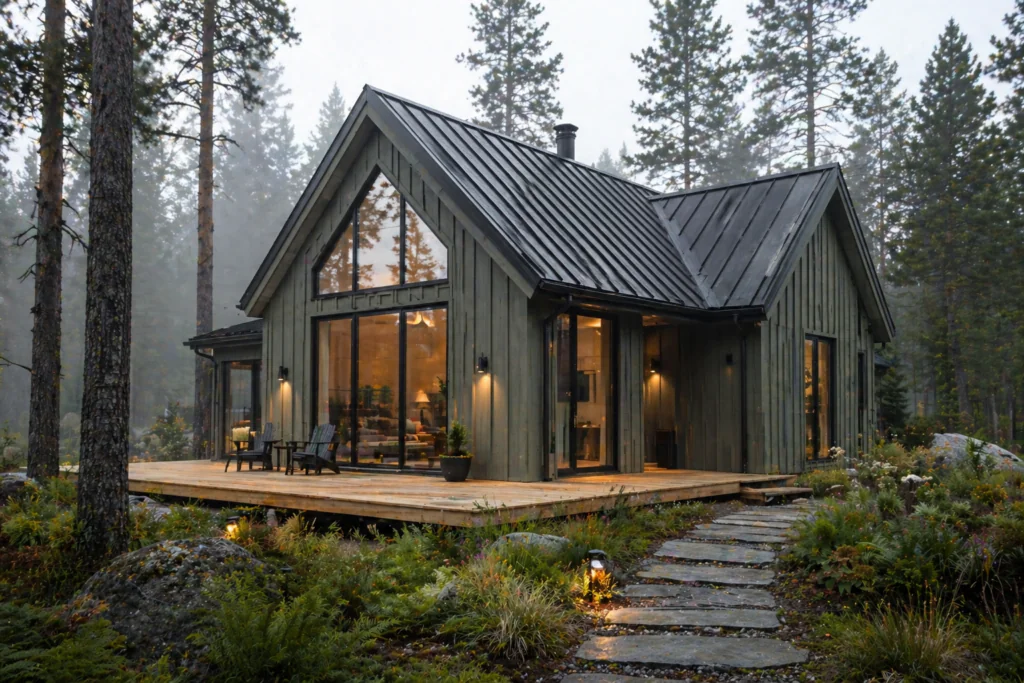
The Scandinavian design philosophy centers on harmony between the built environment and the natural world — and no exterior color serves that mission better than pewter green. Against a backdrop of birch trees or evergreens, a pewter green cabin with a dark metal roof looks as though it has always belonged there.
This style is defined by restraint. Every element earns its place by serving both function and form. Here is how to execute the Scandinavian forest cabin look with pewter green:
Key Design Principles
- Steep high-pitched gable roof in dark charcoal or black metal — functional for snow shedding, visually powerful
- Vertical pewter green cladding — helps rain run off effectively and creates a tall, forest-like silhouette
- Large, slim-framed windows — black aluminum frames maximize glass area without visual clutter
- Natural wood accents confined to the entry threshold, window surrounds, and deck — untreated so they silver naturally over time
- Zero ornamentation — no decorative moldings, no shutters, no flower boxes — let material and form speak
The interior approach should mirror the exterior restraint. White or pale linen walls inside create maximum contrast with the darker exterior, making interior spaces feel bright and expansive even when surrounded by forest. Natural textures — wool, linen, unfinished oak — continue the material story from outside in.
This style suits properties in wooded, mountain, or rural settings but can be adapted to suburban lots with the right landscaping. Planting native trees and allowing the garden to grow in a naturalistic rather than manicured way brings the Scandinavian forest feeling even to urban-adjacent properties.
Idea 6: Coastal Shingle Sanctuary — Breezy and Beautiful
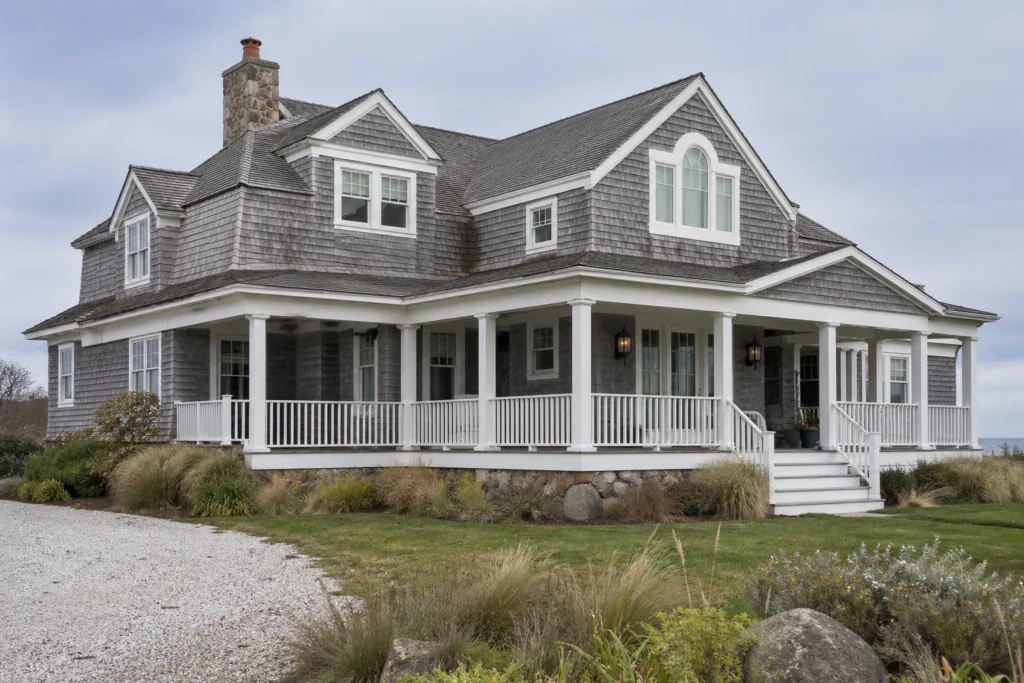
Cedar shingle homes have defined coastal New England architecture for centuries — and pewter green breathes fresh life into this traditional form. Where classic shingle homes often appear in weathered gray or pale yellow, pewter green shingles create a coastal sanctuary feel that is simultaneously familiar and distinctive.
The beauty of this application lies in texture. Cedar shingles add natural visual variation that flat clapboard siding cannot replicate, and pewter green in a shingle form shifts subtly across the surface depending on angle and light — creating depth without any additional effort.
Complete Palette for a Pewter Green Coastal Shingle Home
- Siding: Pewter green cedar shingles — can be pre-stained or painted
- Trim: Crisp pure white on all window casings, door surrounds, corner boards, and fascia
- Foundation: Light gray natural stone or painted concrete block
- Roof: Weathered gray architectural shingles
- Front door: Navy blue, deep coral, or classic black — all work beautifully against pewter green
- Porch railings: White painted wood in a classic style
- Outdoor furniture: Natural teak or white-painted wicker
Landscaping for a coastal pewter green home should feel effortlessly natural. Beach roses, ornamental grasses, lavender, and sea holly all complement the color palette while evoking a seaside mood. A simple gravel or crushed shell pathway reinforces the coastal character right from the curb.
Idea 7: Mid-Century Modern Earth Tones — Retro Meets Nature
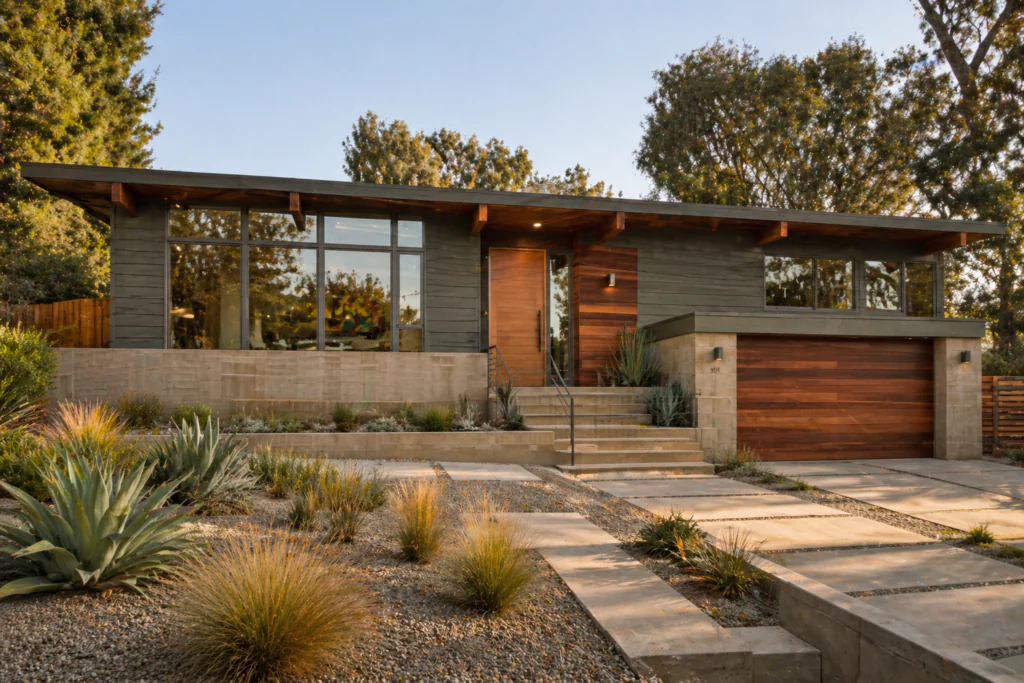
Mid-century modern architecture was always rooted in a philosophy of connecting interiors to the natural world — and pewter green honors that spirit perfectly. This shade aligns with the era’s love of earthy, organic colors that feel in harmony with the landscape rather than imposed upon it.
Ranch homes and split-levels from the 1950s-1970s are experiencing a massive design revival, and pewter green has become the exterior color of choice for homeowners updating these structures while preserving their architectural integrity.
How to Apply Pewter Green to a Mid-Century Modern Home
- Use horizontal siding to echo the low, linear profile of ranch architecture
- Pair with warm wood species — redwood, cedar, or teak — for authentic mid-century warmth
- Choose charcoal or dark bronze trim instead of white — softer, more period-appropriate contrast
- Feature large glass expanses — floor-to-ceiling windows look stunning framed by pewter green
- Consider a carport instead of a closed garage — more authentic to the era, better for curb appeal
- Use warm tan or buff-colored concrete block or stucco on the lower level
| Accent Material | Effect on Pewter Green | Best Use |
| Warm Cedar Wood | Adds golden warmth, softens the gray | Entry surround, fascia, carport |
| Concrete Block | Adds modern weight and texture | Lower foundation or feature wall |
| Tan Stucco | Bridges green and warm earth tones | Lower level cladding |
| Charcoal Trim | Understated contrast, period-correct | Window frames, fascia, garage door |
| Warm Bronze Hardware | Rich, mid-century feel | Door handles, light fixtures |
For the front door on a mid-century modern pewter green home, explore bold options. Mustard yellow, burnt orange, or warm terracotta doors were common in the original era and make a statement today. Alternatively, a slightly deeper green — like a Hunter Green or British Racing Green — creates a refined, tonal entry that still feels distinctive.
How to Choose the Right Pewter Green Paint for Your Home
Not all pewter green paints are equal — and the right choice depends on your home’s orientation, surrounding landscape, existing materials, and your climate. Here is what to consider:
Best Pewter Green Exterior Paints in 2026
- Sherwin-Williams SW 6208 Pewter Green — the benchmark shade with balanced gray-green undertones
- Benjamin Moore HC-134 Tarrytown Green — slightly warmer and deeper, excellent for brick pairings
- Farrow & Ball Mizzle No. 272 — a sophisticated British interpretation with more blue-green character
- PPG1127-5 Pewter Green — a reliable mid-range option with good UV stability
- Behr S390-6 Green Bay — a budget-friendly alternative with excellent coverage
Key Factors When Sampling Pewter Green Exterior Paint
- Always test a large sample (at least 12×12 inches) directly on your home’s exterior — not on cardboard or interior walls
- View the sample at different times of day — morning, noon, and dusk — as pewter green shifts significantly with light
- Observe the sample in both direct sun and full shade — shaded areas make pewter green appear much darker
- Compare against your existing or planned trim color before committing
- In humid or coastal climates, choose a formula with mildew-resistant additives
Frequently Asked Questions About Pewter Green Houses
Does pewter green work in all climates?
Yes — pewter green is a versatile exterior color that performs well across climate zones. In hot, sunny climates, it can appear lighter and more sage-like. In cool or overcast climates, the gray undertones become more prominent. In snowy winters, it provides beautiful contrast against white snow, making your home stand out warmly on the streetscape.
What is the best trim color with pewter green exterior siding?
The most popular and safest trim color with pewter green is bright or warm white — it creates strong contrast that highlights architectural details. For a more sophisticated, understated approach, try cream, ivory, or warm off-white. For contemporary or mid-century styles, charcoal gray or dark bronze trim reduces contrast and creates a sleeker appearance.
Can I use pewter green on just the front door or shutters?
Absolutely. Pewter green makes an excellent front door color on homes with white, cream, tan, or even light gray siding. It also works beautifully as a shutter color. Using pewter green as an accent rather than a primary color is a great way to test the shade and add personality to your exterior without a full commitment.
Is pewter green a good color for resale value?
Generally yes — neutral-leaning earthy greens like pewter green are consistently cited by real estate agents as strong choices for exterior paint. They appeal to a broad audience, feel current without being trendy, and photograph exceptionally well — which matters enormously in today’s online property listing market.
What roof color works best with a pewter green house?
The top three roof options for a pewter green house are: dark charcoal or black (for modern, farmhouse, or Scandinavian styles), weathered gray (for coastal shingle or traditional styles), and warm brown or dark bronze architectural shingles (for Craftsman or mid-century homes). Avoid light tan or cream roofing — it can make the overall palette feel washed out.
Final Thoughts: Why Pewter Green House Ideas Work for Every Style
The enduring appeal of pewter green house ideas comes down to one core quality: the color is rooted in nature. Whether you are building a sleek Scandinavian cabin, restoring a Craftsman bungalow, or updating a 1960s ranch, pewter green connects your home to the organic world around it — making it feel like it belongs exactly where it stands.
From the cool sophistication of a contemporary steel-and-wood home to the relaxed charm of a coastal shingle sanctuary, pewter green adapts without losing its identity. It ages gracefully, photographs beautifully, and pairs with virtually every material that quality exterior design demands.
The seven ideas in this guide are starting points, not prescriptions. Mix principles from different styles. Combine the stone columns of a Craftsman approach with the minimal windows of a Scandinavian form. Use the mid-century horizontal lines with a coastal shingle surface. Pewter green will hold it all together.
Start with large paint samples on your actual exterior wall. Observe them through at least three days and different weather conditions. Then commit with confidence — because pewter green is one of those rare exterior colors that almost always delivers.
You May Also Like These Posts
- DIY Macrame Wall Hangings for Beginners
- Pewter Green Kitchen Cabinet Ideas
- Wall Divider Ideas for Small Apartments
- 2026 Kitchen Trends