
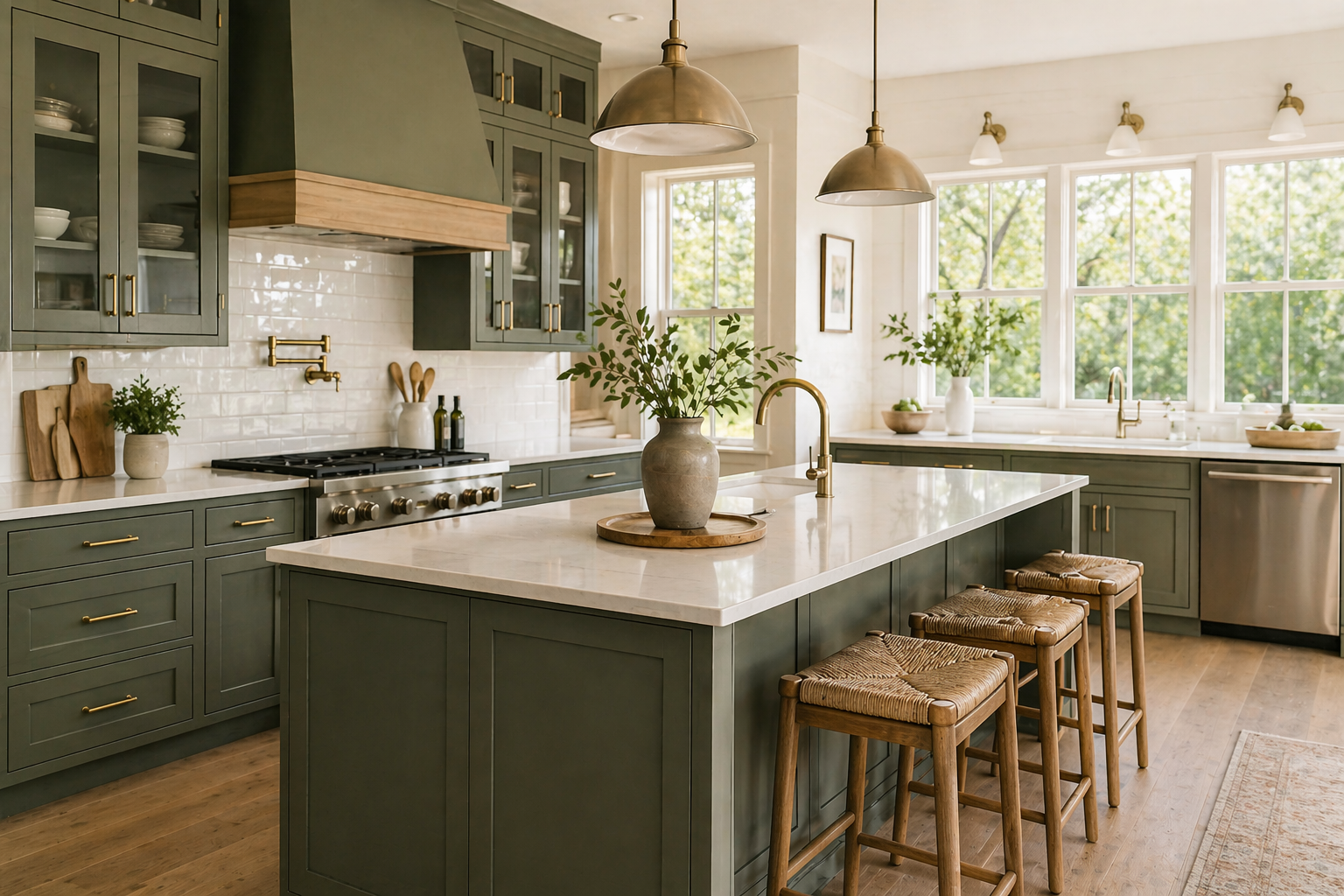
Choosing the perfect cabinet color isn’t easy. White kitchens are timeless but can sometimes feel too safe, while darker shades often make people worry their space will look smaller. That’s exactly why pewter green has become such a favorite—it sits right in the middle.
With its soft blend of green and gray, pewter green brings warmth, depth, and character without overwhelming the room. It’s bold enough to stand out but neutral enough to pair beautifully with white quartz, marble, butcher block, black countertops, natural wood, and almost any hardware finish. Whether your style leans modern farmhouse, Scandinavian, traditional, or contemporary, this versatile color feels right at home.
One of the best things about pewter green kitchen cabinets is that they don’t follow a passing trend. They have a timeless, designer-inspired look that feels just as elegant today as they’ll look years from now. Add warm brass hardware for a classic touch, matte black fixtures for contrast, or oak accents to create a cozy, welcoming kitchen you’ll never get tired of.
In this roundup, you’ll discover 8 stunning pewter green kitchen cabinet ideas that showcase different layouts, finishes, and styling combinations. Whether you’re planning a complete remodel or simply collecting inspiration for your dream kitchen, these ideas will help you create a space that feels stylish, inviting, and effortlessly timeless..
What Are Pewter Green Kitchen Cabinets?
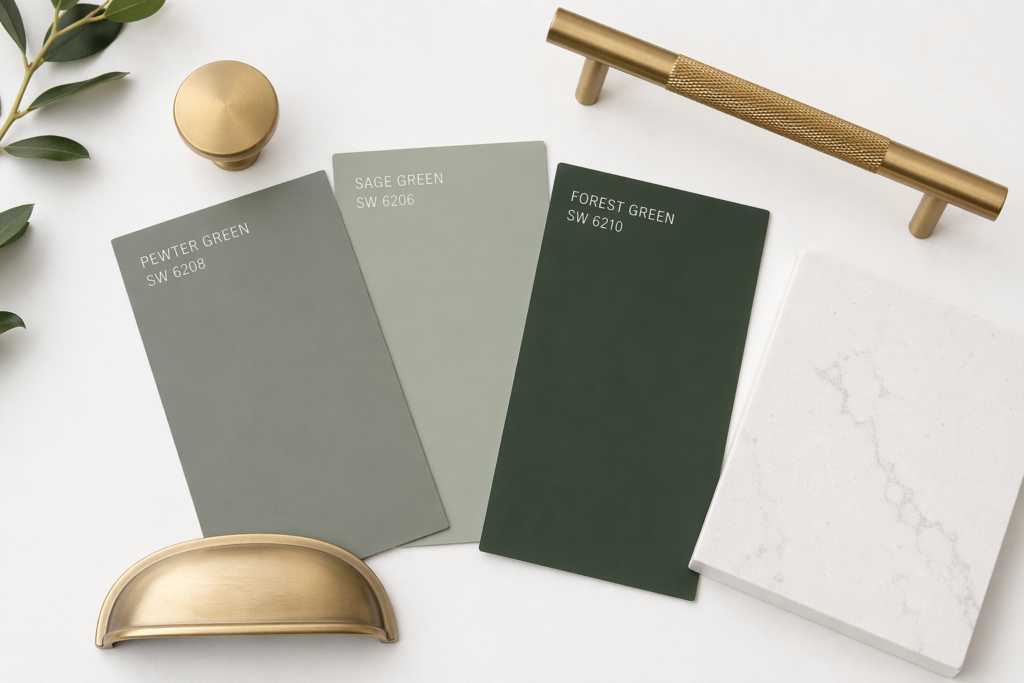
Pewter green is a muted, gray-toned green that takes its name from the metallic pewter alloy — a blend of tin with copper and antimony. As a cabinet color, pewter green typically reads as a cool sage with charcoal undertones, landing somewhere between forest green and warm gray. It’s often described as a “quiet color” — one that commands attention without ever feeling loud.
Popular paint brands offer their own interpretations. Farrow & Ball’s ‘Mizzle’ and ‘Lichen’, Benjamin Moore’s ‘Pewter Green 2140-30′, Sherwin-Williams’ ‘Pewter Green SW 6208’, and Little Greene’s ‘Sage’ all fall into this family. Each has slightly different undertones — some leaning cooler and more gray, others warmer and more sage — so always test samples in your actual kitchen before committing.
Why Pewter Green Is the Perfect Kitchen Cabinet Color
The rising popularity of pewter green kitchen cabinets isn’t accidental. There are several compelling design and practical reasons why this color continues to top renovation wish-lists:
- Timeless, Not Trendy: Pewter green has roots in traditional English country kitchens and Georgian design. It’s been around long enough to feel classic rather than fashionable.
- Extremely Versatile: Pewter green pairs beautifully with warm metals (brass, copper), cool metals (nickel, chrome), natural materials (wood, stone, rattan), and modern finishes (matte black, concrete).
- Works in Any Light: The gray undertones mean pewter green shifts subtly throughout the day — it looks richer in low light and fresher in bright sunlight, giving your kitchen a dynamic, living quality.
- Complements Natural Materials: Stone countertops, terracotta tiles, wood shelving, and linen textiles all work harmoniously with pewter green kitchen cabinets.
- Resale Appeal: Neutral-adjacent colors like pewter green are more broadly appealing to buyers than primary-color choices, making them a smart investment for resale value.
Modern Shaker With Warm Brass Hardware
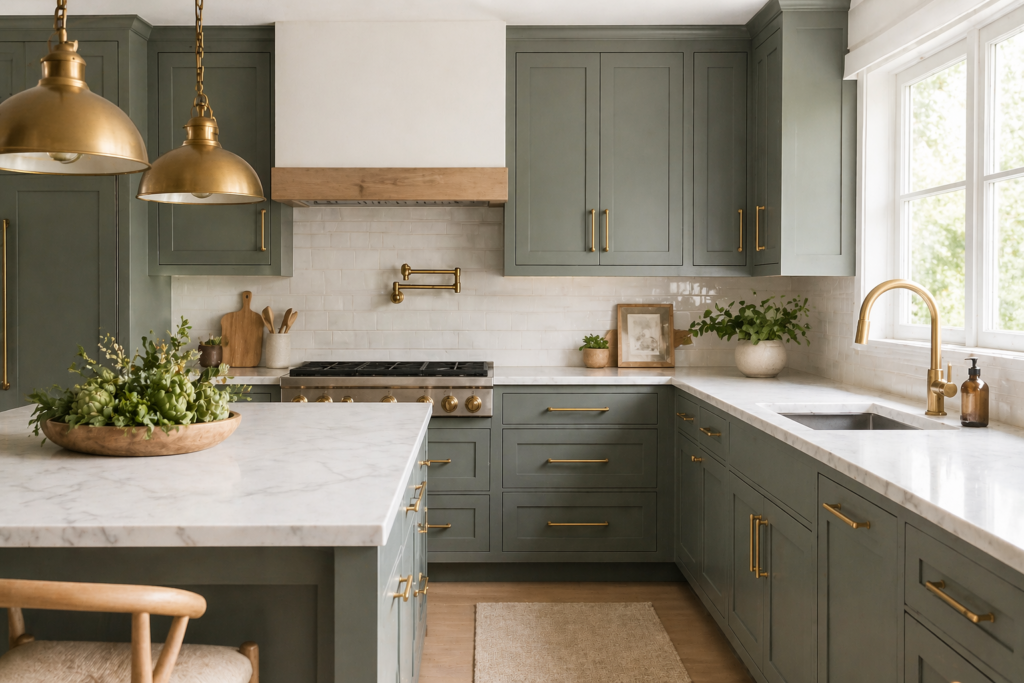
The combination of pewter green shaker cabinets and warm brass hardware is perhaps the most sought-after pairing in contemporary kitchen design — and for good reason. Shaker-style cabinet doors, with their clean recessed panel and simple frame, provide just enough visual detail without competing with the color. Brass hardware adds warmth and a touch of old-world sophistication that elevates the look from merely stylish to genuinely luxurious.
The key to making this combination sing is choosing the right brass finish. Unlacquered brass develops a natural patina over time, giving your pewter green kitchen cabinets a lived-in charm that actually improves with age. Brushed brass stays more consistent and suits modern interiors. Satin brass sits comfortably in between, offering a refined glow without the high shine of polished gold.
Best hardware pairings for pewter green shaker cabinets:
- Long bar pulls (160–192mm) on drawers for a clean horizontal line
- Cup pulls in brushed brass for a vintage nod on lower drawers
- Bin pulls on deep pot drawers for a utilitarian touch
- Matching brass faucet in a bridge or gooseneck style
- Brass pendant lights over the island to echo the hardware below
| 💡 Styling Tip: White Carrara marble or white quartz countertops are the natural partner for this look. The veining in marble adds organic movement, while quartz offers durability without sacrificing visual elegance. Pair with a white subway tile backsplash laid in a classic brick pattern to keep the space bright and balanced. |
The Moody Monochrome Pewter Green Kitchen
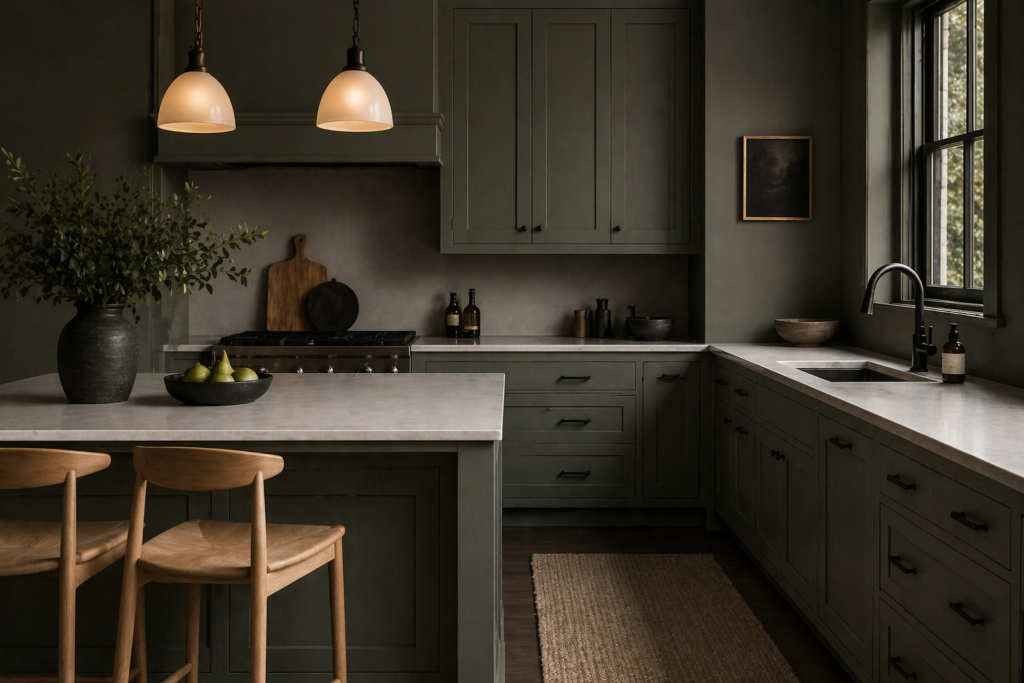
For those willing to commit fully to pewter green kitchen cabinets, the moody monochrome approach delivers a dramatic, high-impact result that feels genuinely unique. The idea is simple: extend the pewter green beyond your cabinets and onto the walls, ceiling, or even island, creating an enveloping, color-drenched environment. When done correctly, this technique makes a kitchen feel intentionally designed rather than assembled piece by piece.
The secret to preventing a monochrome pewter green kitchen from feeling dark or oppressive lies in layering light and texture. Crisp white countertops create vital contrast at eye level. Under-cabinet LED lighting brightens the workspace and casts a warm glow across the green surfaces. A white or light stone backsplash acts as a visual breathing space between wall and cabinet. Matte black hardware sharpens the lines without introducing new colors to manage.
Elements to balance a moody pewter green monochrome kitchen:
- White quartz or marble countertops for brightness
- Natural light — south or east-facing windows are ideal
- Light wood bar stools or dining chairs to warm the space
- Open shelving in light oak or maple to break the green expanse
- Warm-toned bulbs (2700K–3000K) in pendant and recessed lights
| 💡 Designer Insight: In a monochrome kitchen, your lighting becomes even more critical than usual. Layer three types — ambient (recessed), task (under-cabinet), and accent (pendant) — to ensure the space feels warm and functional at every hour of the day. |
Two-Tone Organic Contrast: Green Lowers + White Uppers
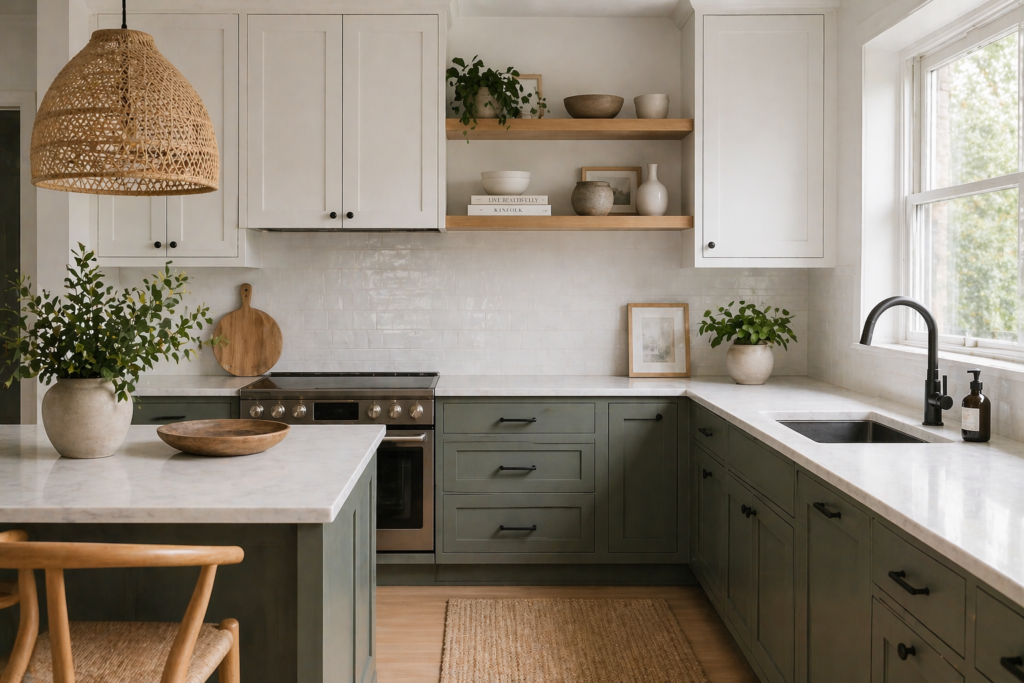
The two-tone kitchen has been a mainstay of contemporary interior design for good reason — it allows you to incorporate a statement color without the all-in commitment of painting every cabinet. Pewter green lower cabinets paired with crisp white upper cabinets is arguably the most popular version of this trend, and it’s a pairing that works across kitchen sizes, layouts, and architectural styles.
The logic is both aesthetic and practical. Darker colors visually ground a space when kept low, creating a sense of stability, while lighter uppers keep the eye moving upward and prevent the room from feeling boxed in. In smaller kitchens especially, white upper cabinets help bounce light around the room, making the pewter green lower cabinets feel like a deliberate design choice rather than a color filling every available surface.
Organic materials that complement the pewter green and white two-tone look:
- Light oak or pale walnut open shelving above the countertop line
- White quartz countertops with subtle movement in the veining
- Rattan or woven pendant shades for warmth and texture
- Linen or cotton Roman blinds in warm white or cream
- Terracotta or ceramic pendant lights for an earthy accent
| 💡 Pro Tip: Use the same hardware finish on both upper and lower cabinets to maintain visual cohesion across the two-tone divide. Matte black hardware is particularly effective here as it reads well against both white and green surfaces without favouring either. |
Idea 4: Rustic Industrial Pewter Green
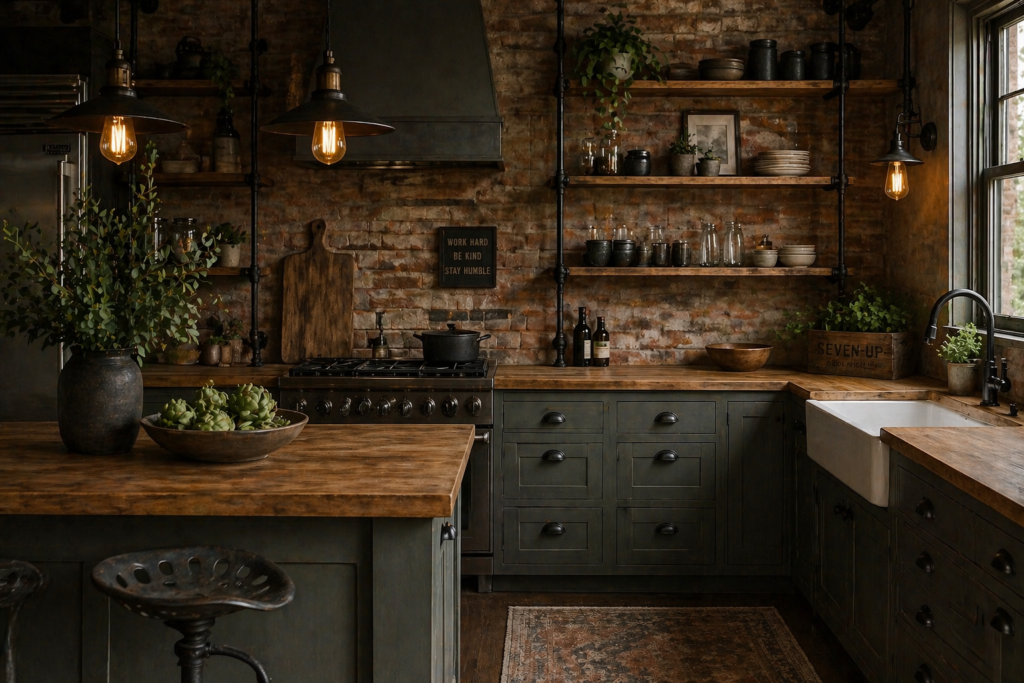
Pewter green kitchen cabinets have an unexpected affinity for raw, industrial materials. The muted gray-green tone acts as a sophisticated counterpoint to rough textures like exposed brick, reclaimed timber, and matte black metalwork — softening what could otherwise feel harsh, while gaining depth and character in return. This is the kitchen for those who want something with genuine personality and a sense of history.
A reclaimed brick backsplash is the cornerstone of this style. The warm red-brown tones in aged brick draw out hidden warmth in pewter green, creating a layered palette that feels entirely natural. Butcher block or live-edge walnut countertops continue the raw material story at eye level. Black iron or wrought iron accents — pipe shelving, cage pendant lights, antique-style bin pulls — provide the industrial edge.
Must-have elements for the rustic industrial pewter green kitchen:
- Reclaimed brick backsplash (or thin brick veneer for easier installation)
- Butcher block or live-edge walnut countertops
- Black iron pipe open shelving for practical display storage
- Edison bulb pendants in black metal cages above the island
- Antique-style bin pulls or cup pulls in oil-rubbed bronze or matte black
- A farmhouse apron sink in white porcelain or aged copper
| 💡 Material Layering Tip: Resist the urge to introduce too many warm metals. In this style, commit primarily to matte black and let raw wood and brick provide the warmth. One or two copper accents — a copper range hood or a single copper faucet — add depth without tipping the look into eclecticism. |
Idea 5: Scandinavian Muted Minimalist
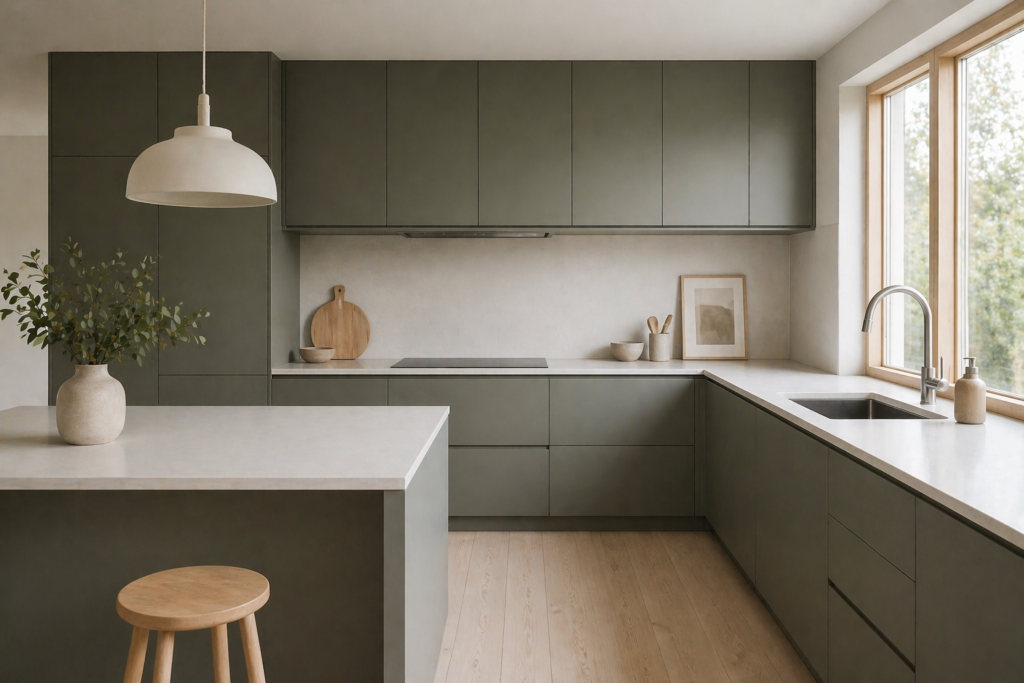
The Scandinavian design philosophy — rooted in function, simplicity, and an almost philosophical restraint — is a natural partner for pewter green kitchen cabinets. In this context, the color is used not as a statement but as a considered choice, one that brings a quiet sense of nature indoors without disturbing the carefully balanced calm that defines the Nordic aesthetic.
Flat-panel cabinet doors (also called slab or handleless cabinets) are the foundation of this style. Their smooth, unbroken fronts keep visual noise to an absolute minimum. Integrated finger pulls or touch-latch mechanisms replace traditional hardware entirely, maintaining the clean lines. The result is a kitchen that feels almost seamless — a series of pewter green planes interrupted only by light-colored countertops and the warm grain of natural wood flooring.
Key principles of the Scandinavian pewter green kitchen:
- Flat-panel or slab cabinet doors with no visible hardware
- White or light grey quartz countertops in a honed or matte finish
- Light ash, birch, or pale oak flooring to warm the space
- Pendant lights in natural materials — wood, rattan, ceramic
- Minimal countertop styling: one cutting board, one ceramic bowl, one plant
- Maximise natural light with large, unobstructed windows
| 💡 Restraint Tip: In a Scandinavian pewter green kitchen, editing is as important as adding. Once you’ve styled the space, remove one item. Then remove another. The resulting spaciousness is the point — it’s what separates Scandinavian design from simple minimalism. |
Idea 6: The Bold Statement Island
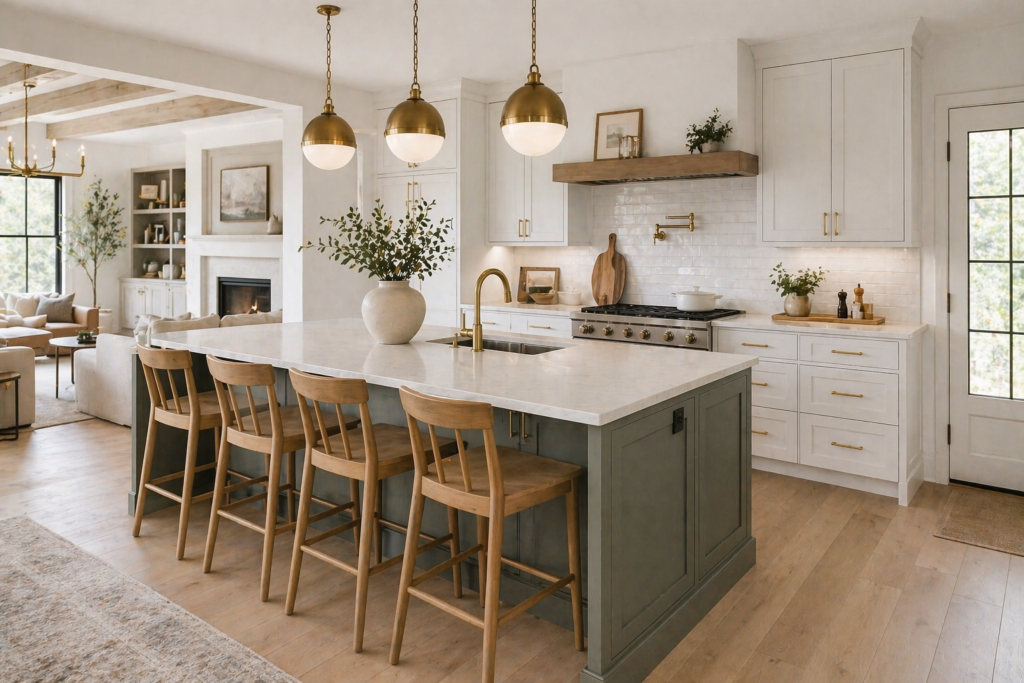
If you love the look of pewter green kitchen cabinets but aren’t ready to commit to painting every surface, a statement island is your ideal entry point. A single pewter green island surrounded by white or off-white perimeter cabinets creates a confident, intentional focal point that anchors the entire kitchen without overwhelming it. This approach works brilliantly in open-plan spaces where the kitchen island serves as a visual anchor for the whole living area.
The size of the island matters enormously to the success of this look. A commanding, oversized island — at minimum 60 inches long, ideally 72 to 96 inches — reads as a deliberate design decision. A small island in pewter green can look like an afterthought. Substantial counter overhang for seating, deep drawers for storage, and a statement countertop material (consider waterfall-edge quartz or honed marble) all contribute to the island’s presence.
Design elements that maximize the pewter green island impact:
- White or off-white perimeter cabinets to create clean contrast
- Waterfall-edge white quartz or honed marble island countertop
- Matte black or brushed brass pendant lights directly above the island
- Bar stools in natural leather or warm wood to add texture
- Integrated appliance drawers or wine fridge in the island base
- A distinct hardware finish on the island vs perimeter for subtle differentiation
| 💡 Spatial Tip: In an open-plan kitchen-dining-living space, use your pewter green island as a design bridge. Paint the kitchen side white to face the dining zone and keep the pewter green facing the kitchen workspace — a clever detail that maintains cohesion from every angle. |
Idea 7: Traditional Inset Cabinet Sophistication
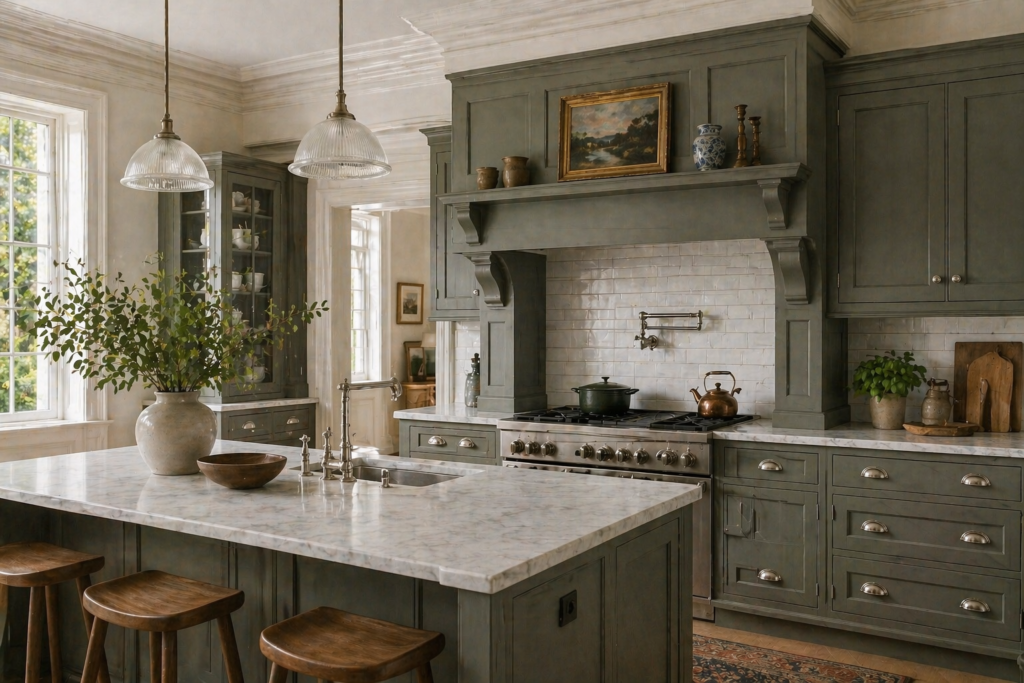
For kitchens with classical proportions — high ceilings, large sash windows, period cornicing — inset pewter green kitchen cabinets are the highest-end, most architecturally appropriate choice. Unlike standard overlay cabinets where the door sits on top of the frame, inset cabinets are recessed flush within the cabinet box, creating exacting reveals around each door and drawer that speak to genuine craftsmanship.
Pewter green is particularly well-suited to inset cabinetry because the color’s muted, complex depth rewards the precision of the construction. The subtle shadows created by the flush reveal lines make the green appear richer and more dimensional. Pair inset pewter green kitchen cabinets with polished nickel hardware — cup pulls on lower drawers, knobs on doors — and you have a kitchen that could pass for a bespoke showroom installation.
Traditional details that complete the inset pewter green aesthetic:
- Crown molding at the top of wall cabinets to meet the ceiling
- Furniture-style feet or bracket base trim on lower runs
- Polished nickel or unlacquered brass cup pulls and knobs
- White Carrara marble countertops with a classic ogee edge profile
- White metro or Devonshire subway tile backsplash with off-white grout
- Integrated larder or pantry cabinet as a focal point on a feature wall
| 💡 Investment Tip: Inset cabinets cost 15–30% more than overlay styles due to the precision required in construction. If budget is a concern, use inset on your perimeter cabinets and standard overlay on your island — the difference is rarely noticeable and the saving is significant. |
Idea 8: Open-Plan Pewter Green With Terrazzo Floors
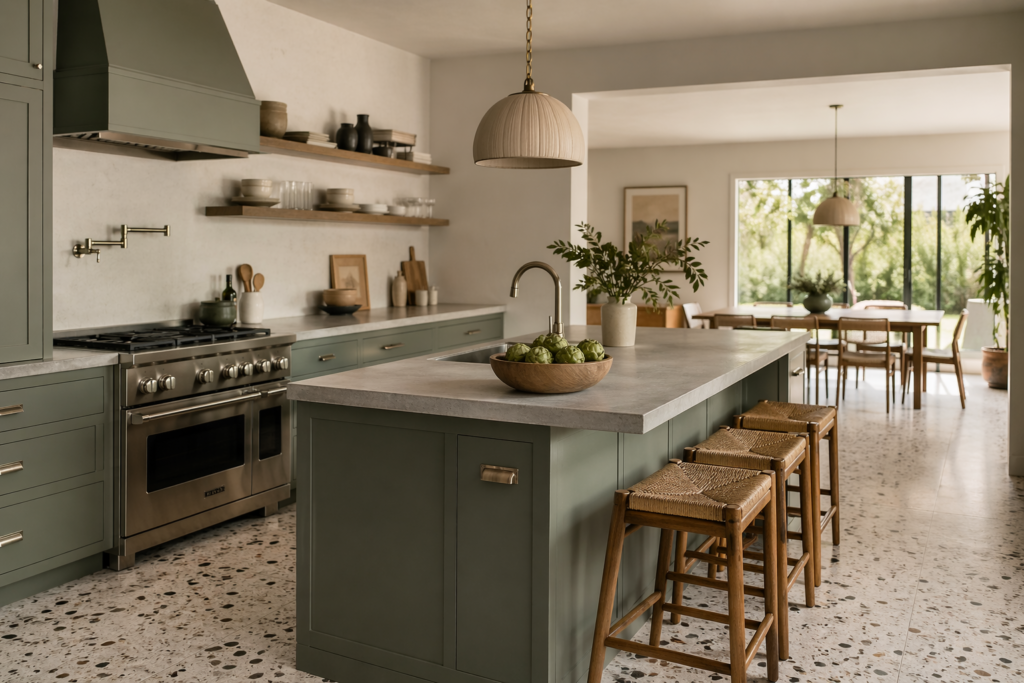
Terrazzo flooring has made a triumphant return to interior design, and its speckled, multi-toned surface is one of the most unexpected and successful partners for pewter green kitchen cabinets. Whether your terrazzo features warm coral and cream chips, cool grey and white, or a neutral blend, the organic randomness of the pattern provides a perfect visual foil for the considered, calm tone of pewter green.
This pairing works best in open-plan spaces where the terrazzo floor flows continuously from kitchen into dining and living zones. The pewter green cabinetry anchors the kitchen area visually without requiring a physical partition. Keep the upper cabinetry either white or open shelving to allow the terrazzo and green to breathe. A concrete or stone benchtop in a warm grey or creamy tone completes the material palette.
Design tips for the terrazzo + pewter green kitchen combination:
- Choose terrazzo chips in warm neutrals — cream, terracotta, soft grey — to complement pewter green
- Use open shelving on at least one wall to prevent the space from feeling heavy
- Warm-toned concrete or engineered stone countertops in a honed finish
- Brushed nickel or matte black faucet and hardware in a simple profile
- Introduce a pendant in natural ceramic or woven cane as a design bridge
- Keep soft furnishings — bar stools, curtains — in linen, cream, or warm white
| 💡 Color Connection Tip: When selecting your terrazzo, look for chips that contain a hint of the same gray-green found in your pewter green cabinets. This subtle repetition of tone creates a cohesive, curated palette that looks intentional rather than coincidental. |
How to Choose the Right Shade of Pewter Green
Not all pewter greens are created equal. The term covers a spectrum of gray-greens that vary significantly depending on brand, undertone, and finish. Here’s how to navigate the choice confidently.
- Cooler Pewter Greens: Lean more gray with blue or teal undertones. Work best in kitchens with warm lighting and warm-toned natural materials like walnut or terracotta. Examples: Farrow & Ball ‘Mizzle’, Sherwin-Williams ‘Pewter Green SW 6208’.
- Warmer Pewter Greens: Carry more olive or khaki in their base. Suit kitchens with cooler stone floors and white cabinetry. Examples: Benjamin Moore ‘Pewter Green 2140-30’, Little Greene ‘Sage’.
- Testing Your Swatch: Always paint a 12-inch square directly onto your cabinet door and observe it at different times of day before committing. Morning light and evening lamplight can shift the color dramatically.
- Finish Matters: Eggshell or satin finish is recommended for kitchen cabinets — it’s durable, wipeable, and provides just enough sheen to catch light without highlighting imperfections.
Best Hardware Finishes for Pewter Green Kitchen Cabinets
Hardware is where you can dramatically shift the mood of pewter green kitchen cabinets. The same cabinet color paired with different hardware finishes produces entirely different results:
- Brushed Brass: Warm, sophisticated, works in modern and traditional kitchens. The go-to choice for a luxurious feel.
- Matte Black: Sharp, contemporary, creates high contrast. Ideal for minimalist or industrial-inspired designs.
- Polished Nickel: Cool, refined, timeless. Perfect for traditional or Georgian-style kitchens with inset cabinetry.
- Brushed Nickel / Satin Chrome: Versatile and understated. Works across almost every kitchen style without commanding attention.
- Oil-Rubbed Bronze: Dark, warm, antique feel. Best suited to rustic, farmhouse, or artisan kitchen designs.
- Unlacquered Brass: Develops a natural patina over time. For those who appreciate a kitchen that ages beautifully.
Pewter Green Kitchen Cabinets: Pros and Cons
Pros
- Timeless color with roots in traditional design — unlikely to feel dated
- Extremely versatile — works with warm and cool tones, multiple hardware finishes
- Sophisticated without being loud or polarizing
- Pairs beautifully with natural materials: stone, wood, terracotta, linen
- Strong resale appeal — neutral enough for broad buyer preference
- Available from most major paint brands in a wide price range
Cons
- Can feel cold in north-facing kitchens without careful lighting design
- Darker than white, so smaller kitchens may feel more enclosed
- Requires more maintenance than white — shows grease marks and fingerprints more readily
- Choosing between the many shade variations can be overwhelming without professional guidance
You May Also Like These Posts
Frequently Asked Questions
Are pewter green kitchen cabinets timeless?
Yes. Pewter green sits in the grey-green family that has been a fixture of English country house kitchens for centuries. Unlike trend-driven colors such as millennial pink or cobalt blue, pewter green has a classical heritage that anchors it firmly in the timeless category.
What countertop goes with pewter green kitchen cabinets?
White quartz is the most popular choice for its brightness and practicality. White marble (real or engineered) adds luxury and movement. Honed concrete or warm grey stone works well in industrial or Scandinavian-inspired kitchens. Butcher block walnut is ideal for rustic or farmhouse styles.
What hardware colour goes with pewter green cabinets?
Brushed brass is the most popular and versatile choice, adding warmth to the cool green. Matte black is the contemporary alternative for a sharper, more modern look. Polished nickel suits traditional cabinetry styles best. All three can work — the right choice depends on the overall design direction of your kitchen.
Can I use pewter green cabinets in a small kitchen?
Yes, with some planning. Use pewter green on lower cabinets only and keep uppers white to preserve the sense of height and brightness. Maximise natural light where possible and add under-cabinet lighting. Avoid the moody monochrome approach in very small spaces.
Is pewter green the same as sage green?
Not exactly. Sage green tends to be lighter, softer, and more clearly green. Pewter green has stronger grey undertones, making it feel more muted, sophisticated, and slightly darker. They’re close relatives but produce noticeably different results in a kitchen setting.
How do I maintain pewter green kitchen cabinets?
Wipe down regularly with a soft damp cloth and a mild dish soap solution. Avoid abrasive cleaners which can damage the paint finish. Re-seal or re-paint every 7–10 years depending on wear. Choose a satin or eggshell finish initially for the best balance of durability and cleanability.
Final Thoughts
Pewter green kitchen cabinets represent one of the most intelligent color choices available to today’s homeowner. This quiet, complex shade offers genuine design versatility — at home in a sleek Scandinavian flat in the city as easily as in a rambling country farmhouse. Whether you opt for the warmth of brass-paired shakers, the drama of a full monochrome scheme, the practicality of a two-tone layout, or the statement impact of a single pewter green island, this is a color that rewards commitment.
The 8 pewter green kitchen cabinet ideas in this guide cover the full spectrum of design possibilities — from the reassuringly traditional to the boldly contemporary. Use them as a starting point for your own kitchen renovation, adapt the hardware and material suggestions to suit your budget and taste, and don’t be afraid to test multiple shade samples before committing. The right pewter green is out there — and when you find it, your kitchen will never have looked better.