
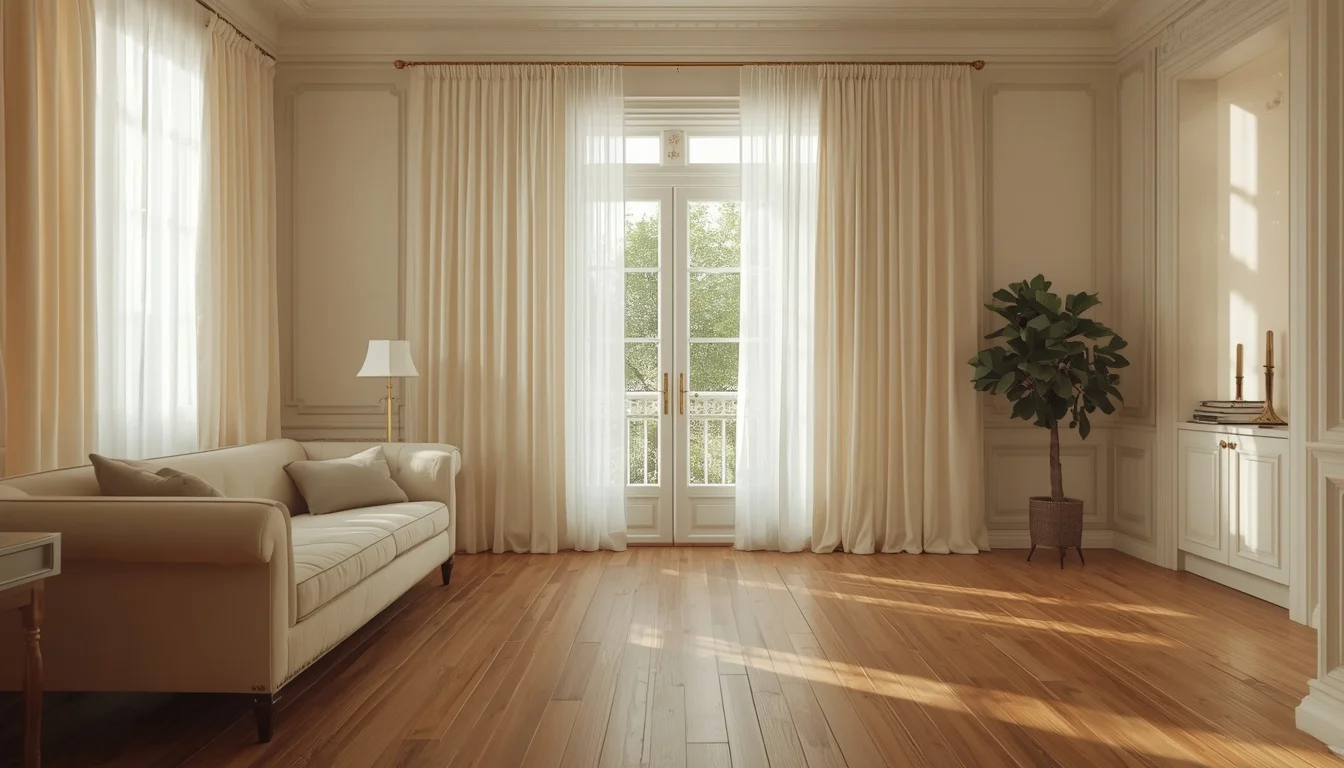
1. The Moment I Realised Curtains Could Make or Break a Room
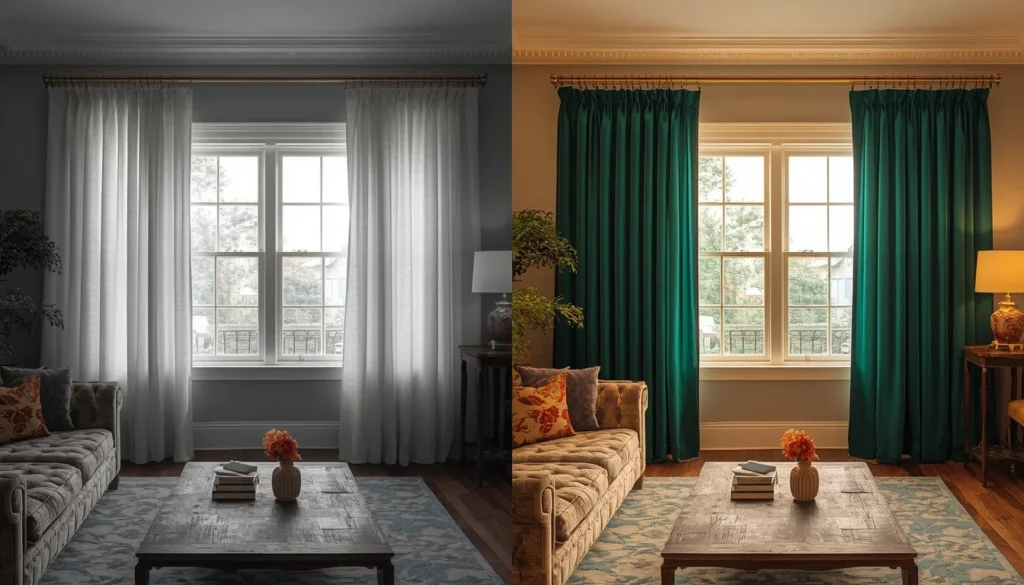
Luxury curtains for living room spaces were the last thing on my renovation budget. I’d spent months picking the right sofa colour, obsessing over tile samples, and arguing with my partner about whether the accent wall should be sage or forest green.
The curtains? I thought I’d just grab something from IKEA and call it done.
Then a friend visited, looked around our freshly decorated living room, and said — not unkindly — “Everything looks great. Are you still waiting for the proper curtains to arrive?”
We had installed them the day before. Those were the curtains.
That stung enough that I went down a proper rabbit hole over the next three months: measuring twice, sampling fabrics, visiting showrooms, watching more YouTube videos about pinch pleat versus eyelet heading than any reasonable person should. We eventually bought two sets of luxury velvet curtains, had them custom made, and the difference they made was so dramatic that even my teenage son noticed without being told.
If you’re about to furnish or upgrade a living room and you’re wondering whether luxury curtains are actually worth the money — this guide is what I wish I’d had before I started.
2. Why Luxury Curtains for Living Room Actually Matter (It’s Not Just Aesthetics)
I used to think curtains were purely decorative. You hang them, they look nice, done. That was my thinking before I learned what they actually do.
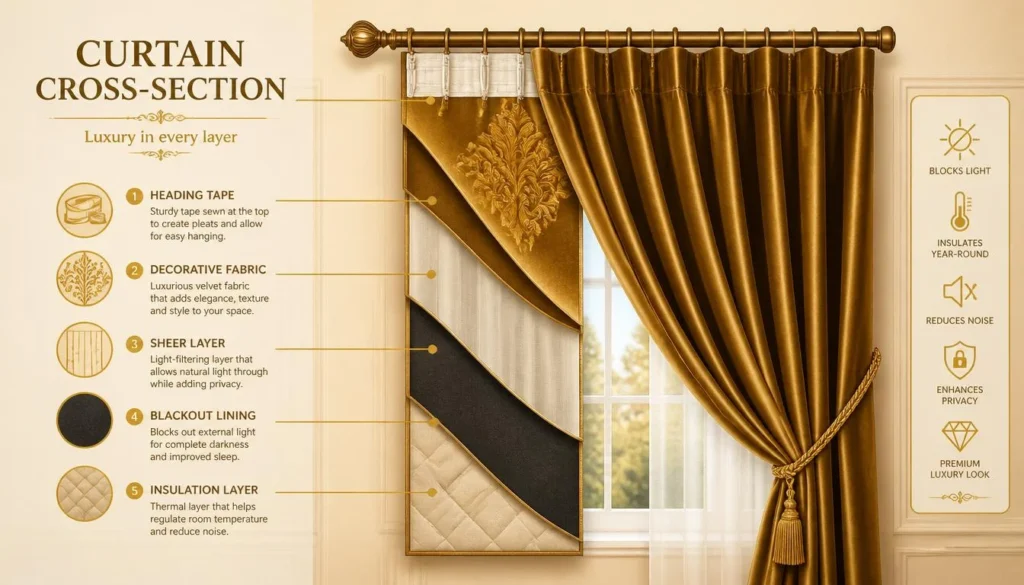
Good luxury curtains for a living room serve at least four functional roles simultaneously:
- Light control — high-quality lined or blackout options block harsh afternoon glare without making the room feel like a cave
- Thermal insulation — thick fabrics like velvet reduce heat loss through windows by a measurable margin, which affects your energy bills
- Acoustic dampening — heavy drapes absorb sound, which matters in open-plan homes or rooms near busy roads
- Privacy — sheer underlayers plus opaque main drapes give you full flexibility throughout the day
The aesthetic part is obvious. But once I understood these functional layers, I stopped seeing luxury curtains as an indulgence and started seeing them as a structural investment in the room.
3. The Fabric Question: What Actually Looks Luxurious and Holds Up Over Time
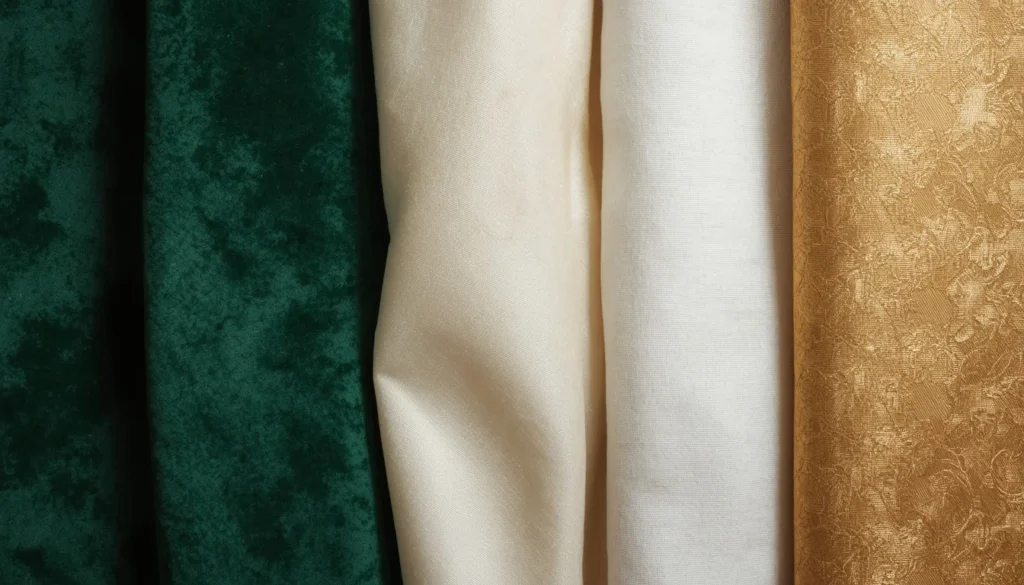
This is where most first-timers go wrong. They assume the most expensive fabric is always the right choice. It’s not. The right fabric depends on how much light hits your windows, whether you have kids or pets, and what look you’re going for.
Here’s what I learned from visiting three different curtain showrooms and talking to two interior designers:
Velvet
This is what we ended up choosing for our main living room panels. Velvet has a richness and depth that photographs beautifully and looks genuinely expensive even from across the room. It’s also heavier, which means it hangs in beautiful, clean vertical folds without a lot of effort.
Downside: velvet shows dust and pet hair readily, and it can develop “crushing” — small marks where something presses against it. We have two cats, and this is a constant mild battle.
Silk and Faux Silk
Real silk looks phenomenal but it’s genuinely difficult to maintain. It fades faster than almost any other fabric when exposed to direct sunlight, and dry cleaning every time adds up quickly. Faux silk (polyester satin weaves) has come a long way in 2025–2026 and honestly looks nearly identical from a normal viewing distance. I’d suggest faux silk unless you have north-facing windows with minimal direct sun.
Linen and Linen Blends
Linen is having a massive moment right now in 2026 interior design, and honestly, rightfully so. It’s breathable, it drapes beautifully, and it has a relaxed elegance that works especially well in rooms with natural wood tones, rattan furniture, or a Scandinavian or coastal aesthetic. It won’t give you the dramatic pooling effect of velvet, but it feels light and airy in a way that heavier fabrics can’t replicate.
Cotton and Cotton Blends
More affordable, easier to clean, and more forgiving if you’re not sure about a colour choice. Cotton doesn’t have the same sheen or weight as velvet or silk, but for a more casual living room, or if you’re going for a French country or cottage feel, cotton is excellent.
Jacquard and Brocade
These are woven fabrics with patterns built into the weave itself rather than printed on the surface. They look genuinely luxurious up close, but they’re heavier and harder to work with. Best for formal living rooms where they won’t be disturbed much.
4. 15 Luxury Curtain Ideas for Living Room with Full Comparison
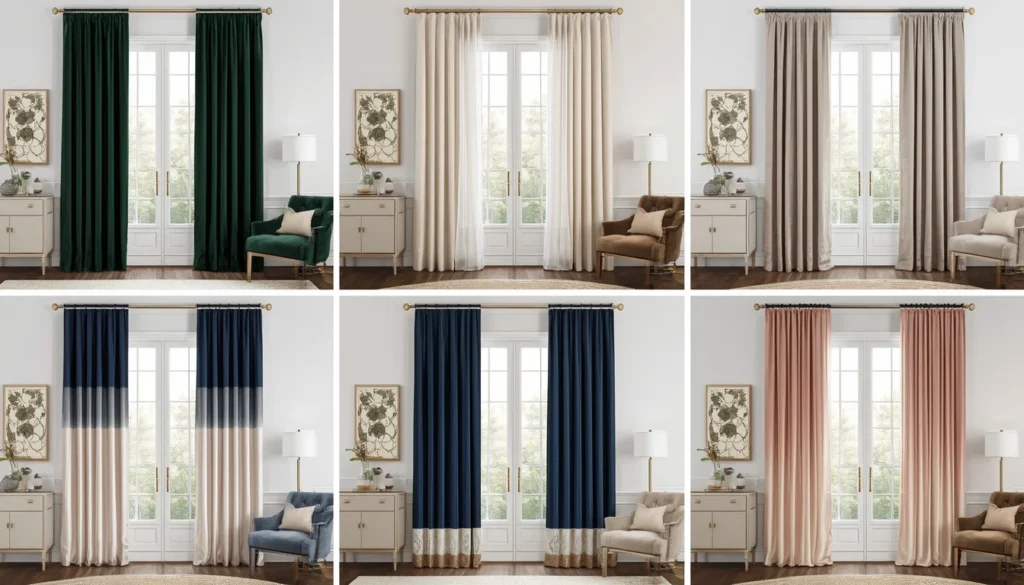
I pulled together every style I’ve either tried personally, seen in showrooms, or had recommended by the two designers I consulted. I’ve rated each one honestly based on real-world factors, not just how they look in staged photos.
| # | Curtain Style | Best Fabric | Room Style | DIY Friendly | Avg Cost (full set) | Wow Factor | Maintenance |
| 1 | Floor-to-Ceiling Velvet Drapes | Velvet | Classic / Glam | Medium | £800–2,200 | 10/10 | Medium |
| 2 | Ivory Silk Sheer + Blackout Layers | Faux Silk | Modern Luxe | Medium | £600–1,800 | 9/10 | Low |
| 3 | Linen Drapes in Warm Neutrals | Linen Blend | Coastal / Scandi | Easy | £300–900 | 7/10 | Very Low |
| 4 | Brocade Curtains in Deep Jewel Tones | Jacquard | Formal / Traditional | Hard | £1,000–3,000 | 9/10 | High |
| 5 | Emerald Green Velvet with Gold Rods | Velvet | Statement / Glam | Medium | £900–2,400 | 10/10 | Medium |
| 6 | French Pleat Ivory Linen | Linen | French Country | Medium | £400–1,200 | 8/10 | Low |
| 7 | Navy Blue Velvet with Brass Hardware | Velvet | Contemporary Classic | Medium | £800–2,000 | 9/10 | Medium |
| 8 | Sheer White Layered with Grey Velvet | Mixed | Modern Minimalist | Medium | £500–1,500 | 8/10 | Low-Med |
| 9 | Burnt Orange Silk Drapes | Faux Silk | Eclectic / Boho | Medium | £500–1,400 | 8/10 | Low |
| 10 | Cream Brocade with Embroidered Edge | Brocade | Traditional Luxury | Hard | £1,200–3,500 | 10/10 | High |
| 11 | Grey Linen Tab-Top Panels | Linen | Industrial / Modern | Very Easy | £250–700 | 6/10 | Very Low |
| 12 | Charcoal Blackout Velvet | Velvet | Cosy / Cinema Room | Medium | £700–1,800 | 8/10 | Medium |
| 13 | Patterned Chinoiserie Curtains | Cotton Blend | Eclectic Luxe | Hard | £800–2,200 | 9/10 | Medium |
| 14 | Blush Pink Silk Ombre Drapes | Faux Silk | Romantic / Feminine | Medium | £600–1,600 | 8/10 | Low |
| 15 | Pleated Taupe Wool-Blend Drapes | Wool Blend | Understated Luxury | Medium | £700–1,900 | 8/10 | Low |
A few things I want to flag from that table because they surprised me when I was researching:
The brocade options (#4 and #10) look absolutely spectacular in person but they are genuinely hard to hang well. The weight distribution is uneven, and if you’re not using a professional fitter, they have a tendency to look slightly lopsided no matter what you do.
The linen options (#3, #6, #11) are far easier to live with day-to-day than anything velvet. My sister has the linen version and I’m occasionally jealous of how zero-effort her curtains are compared to mine.
The charcoal blackout velvet (#12) deserves a special mention for people with south or west-facing living rooms. We trialled one panel and the difference in room temperature during summer afternoons was noticeable enough that I seriously considered switching.
5. Hardware Matters More Than You Think: Rods, Rings, and Finials
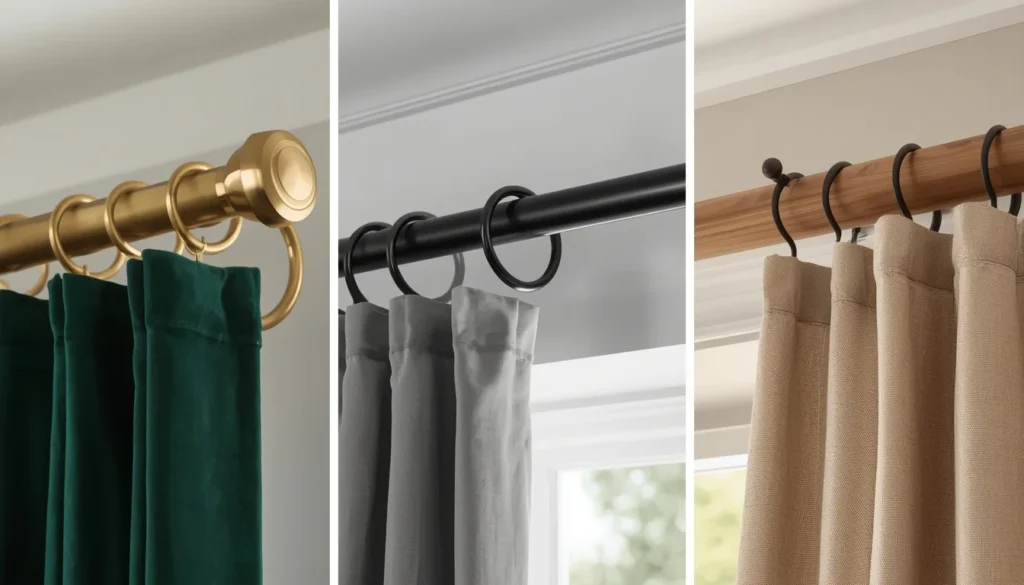
This was the piece of advice I ignored and then had to unlearn. I bought beautiful custom velvet curtains and hung them on a basic chrome rod from a DIY store because “it’s just functional, who cares.”
My interior designer friend nearly had a breakdown when she visited.
The rod is visible. The finials (the decorative ends of the rod) are visible. The rings or the heading style where the curtain meets the hardware — all visible. All of it affects the finished look.
What actually works with luxury curtains for living room:
- Brushed brass or antique brass hardware — works with warm tones (cream, gold, emerald, burnt orange)
- Matte black rods and rings — looks sharp with navy, charcoal, and grey curtains in a contemporary space
- Polished nickel or chrome — best with cool-toned rooms: white, light grey, pale blue
- Wooden rods — natural oak or walnut rods suit linen and cotton drapes in Scandi or rustic settings
Rod diameter also matters. Thin rods sag visually under heavy fabric. For floor-to-ceiling velvet panels, you want a rod with at least a 28mm diameter, ideally 35mm or more.
6. Heading Styles Decoded: Pinch Pleat, Eyelet, Goblet, and More
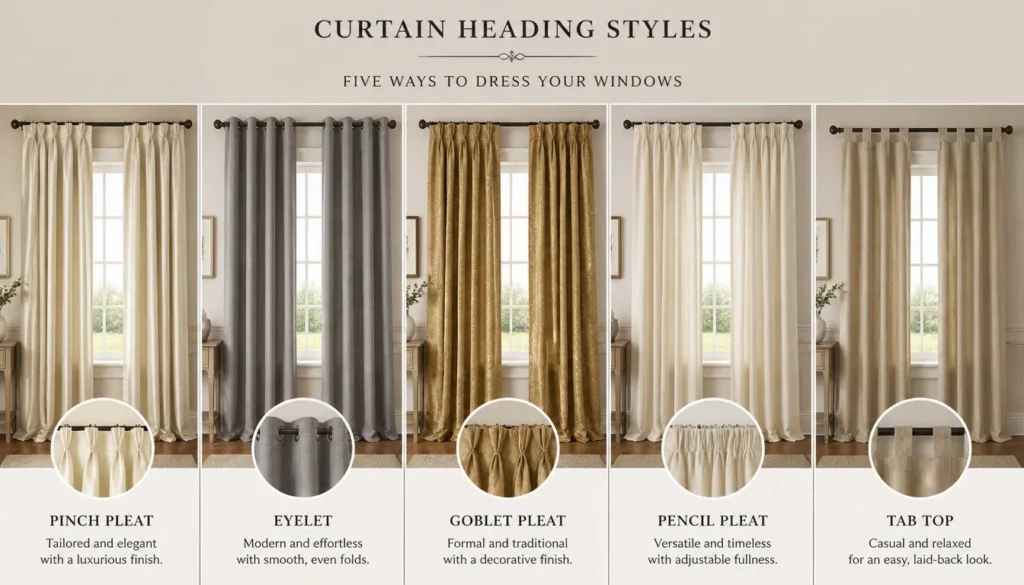
The heading is the top of the curtain — how it’s folded and attached to the rail or rod. This is one of the most visible parts of the whole setup and one of the most confusing for first-timers.
Here’s a plain-English breakdown of the main options:
Pinch Pleat
The classic heading for formal luxury curtains. The fabric is gathered into tight groups of two or three folds that hang in neat, even columns when the curtain is open. It looks extremely expensive and works beautifully with velvet, silk, and brocade. It requires specific hooks and a compatible rail, so check compatibility before ordering.
Eyelet / Grommet
Large metal rings are punched through the top of the fabric and slid directly onto a rod. This is the most contemporary look and works best with lighter fabrics like linen or faux silk. It doesn’t suit heavy velvet as well because the weight distribution pulls the rings apart awkwardly. Very easy to install yourself.
Goblet Pleat
Each pleat forms a cup or goblet shape at the top. This is genuinely the most opulent-looking heading style and is typically reserved for formal or statement curtains. You see this most often in high-end hotels and traditional Georgian or Victorian interiors.
Pencil Pleat
Tightly gathered across the full width with a narrow tape at the top. Very versatile, works with most fabrics, and is the most common heading in UK homes. It looks smart without being as formal as pinch pleat.
Tab Top
Fabric loops at the top slide directly over a rod. Very relaxed and casual — this is the linen tab-top option (#11 in my list). Not suitable for curtains you need to open and close frequently as it doesn’t slide as smoothly.
7. How to Actually Buy Luxury Curtains for Your Living Room (Step by Step)

Based on what I went through — and the two sets I ended up buying before getting it right the second time — here’s the process I’d follow if I was starting from scratch today.
- Measure your windows properly. Measure width and drop twice, in different spots. Window frames are rarely perfectly square. For a luxury look, your curtain width should be 2 to 2.5 times the track or rod width — this is what creates that full, gathered look.
- Decide on your lining. Unlined curtains look flat and thin regardless of the fabric quality. At minimum, go for a standard lining. For a premium result, choose an interlining (a layer of bump fabric between the main fabric and the lining) which gives curtains that heavy, sculpted drape you see in designer rooms.
- Order fabric samples before committing. Every fabric showroom and most online retailers will send samples. Pin them to your window, look at them in morning light and evening light, and live with them for 2–3 days. Colours look completely different depending on the time of day.
- Choose your heading style based on your rail type. Not all headings work with all rails. If you have a pole, eyelet or tab top is easiest. If you have a track hidden by a pelmet, pencil pleat or pinch pleat looks cleanest.
- Budget for professional making and fitting if possible. DIY curtain hanging is absolutely possible, but for floor-to-ceiling panels in a fabric like velvet or brocade, a professional fitting makes a significant visual difference. The curtain needs to hang plumb from the first day to avoid distorting the fabric.
- Don’t forget the hardware. Order your rod, brackets, rings, and finials before the curtains arrive so you’re not waiting for a delivery after the curtains are ready.
- After hanging, steam (don’t iron). Steam relaxes the fabric and encourages the folds to set. A handheld garment steamer works perfectly. Never iron velvet or silk directly.
8. Mistakes I Made (So You Don’t Have To)
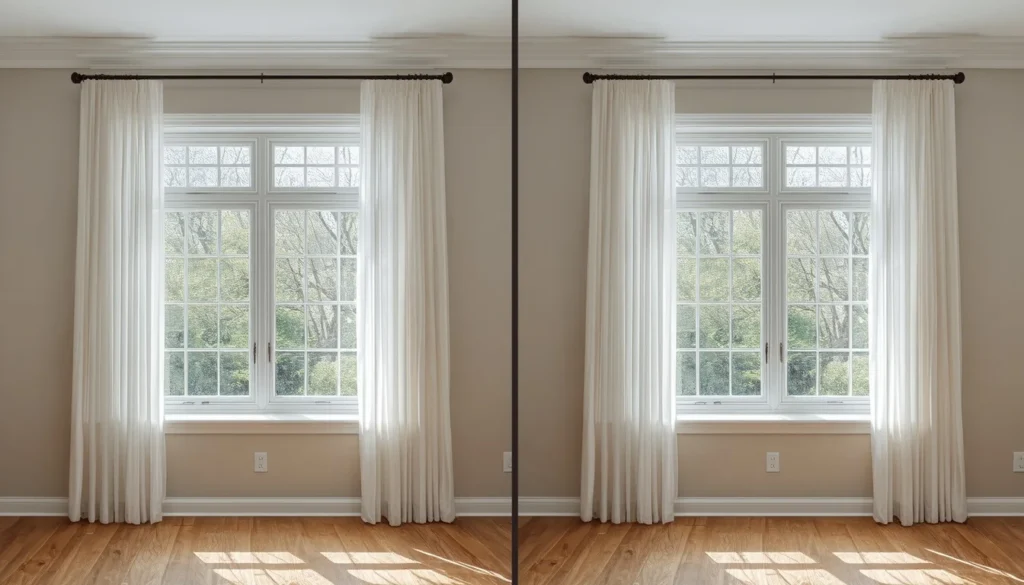
These aren’t hypothetical. These are things that happened in our actual house, with actual money we spent.
Mistake 1: Hanging the rod too low
I hung the first rod about 10cm above the window frame. This is the instinctive thing to do but it’s visually wrong. The rod should be hung as close to the ceiling (or ceiling coving) as possible. High rods make the room look taller. It sounds minor. It isn’t.
Mistake 2: Not accounting for the return
The ‘return’ is the distance between the back of the curtain ring and the wall. If your curtains don’t return to the wall at the sides, you get light leaking around the edges and the curtains look like they’re floating in space rather than framing the window. Always ask for curtains with a side return included in the measurement.
Mistake 3: Choosing a fabric I loved in small swatch but not at scale
I picked a beautiful copper-gold jacquard from a small sample. At full curtain scale — floor to ceiling, two wide panels — the pattern became overwhelming and fought with everything else in the room. Always try to see the fabric at a bigger scale before ordering. Some showrooms will let you borrow a larger length.
Mistake 4: Not getting them properly dressed after hanging
After hanging new curtains, you need to ‘dress’ them — physically arrange and tie each fold by hand, then leave them for 24–48 hours so the folds set into the fabric. I didn’t know this the first time. The curtains just hung in a slightly random shape. Once I learned to dress them properly, they looked completely different.
Mistake 5: Choosing the wrong white
I tried ‘bright white’ sheers once. In our room with warm plaster tones and wood floors, they looked cold and clinical. Pure white curtains almost never look luxurious — off-white, ivory, oyster, or warm cream almost always reads as more expensive.
9. Luxury Curtain Trends for Living Rooms in 2026
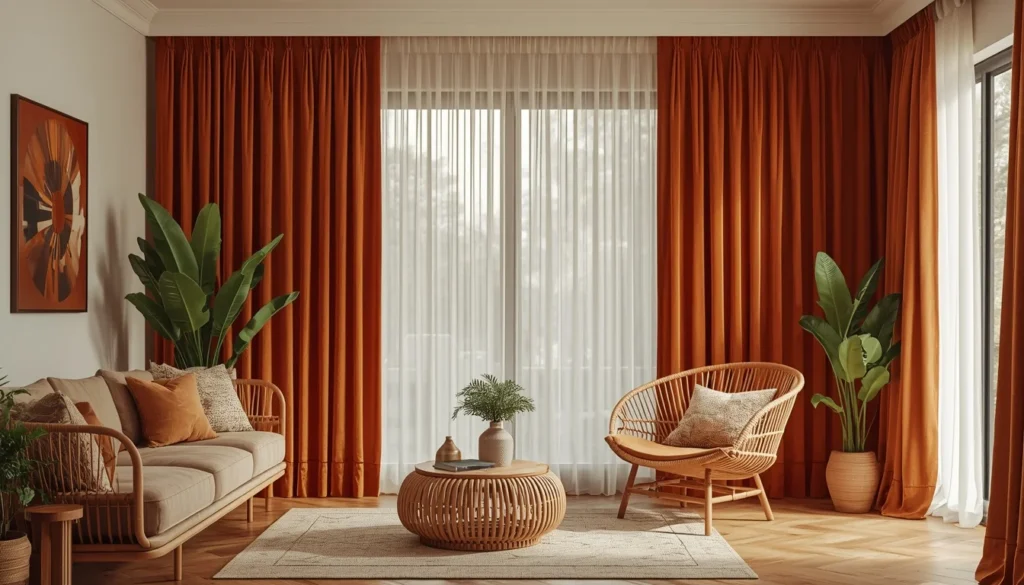
I asked both the designers I worked with what they’re seeing most in 2026 commissions, and I cross-referenced that with what’s being featured in Architectural Digest, House Beautiful, and the major fabric showrooms like Colefax and Fowler and Designers Guild. Here’s what’s actually trending right now:
- Earthy, botanical tones — terracotta, moss green, clay, and warm sand are replacing the all-grey palette that dominated the last decade. These colours in velvet or textured linen look genuinely modern.
- Quiet luxury — the anti-maximalism trend continues. Curtains in single, rich colours with no pattern and beautifully crafted headings. Understated but clearly expensive.
- Layering — a sheer layer under a heavier drape is everywhere right now. Gives flexibility, looks high-end, and manages light beautifully throughout the day.
- Pleat revival — goblet and pinch pleats are coming back strongly after years of eyelet dominance. They signal craftsmanship and work perfectly with the quiet luxury aesthetic.
- Organic textures — weaves with visible texture (bouclé, slubbed silk, textured linen) are more interesting in person than flat, smooth fabrics and photograph extremely well for interiors content.
- Floor pool — allowing the curtain to pool slightly on the floor (an extra 5–15cm of fabric) is back as a sign of intentional luxury rather than poor measuring.
10. Real Cost Breakdown: What Luxury Curtains Actually Cost in 2026
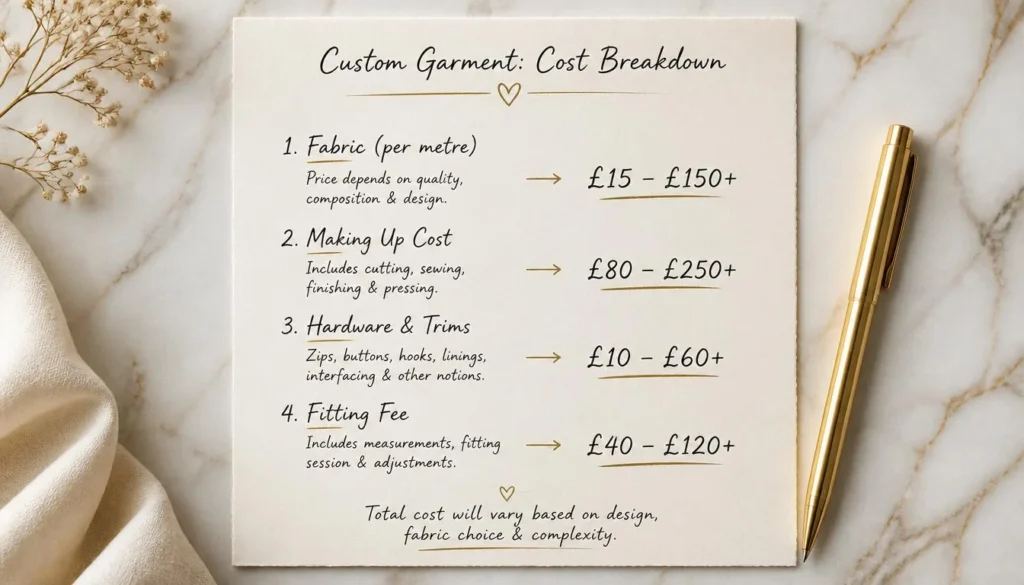
This is the section I couldn’t find anywhere when I was researching, so I’m including real numbers based on my own purchases and quotes I received from UK suppliers in 2025–2026. Prices will vary by region but the proportions are instructive regardless.
| Cost Element | Budget Option | Mid-Range | True Luxury |
| Fabric (per metre) | £8–20 | £25–70 | £80–300+ |
| Making up (per curtain) | £60–100 | £100–200 | £200–500+ |
| Lining | Included/basic | Standard lining | Interlining + blackout |
| Curtain pole + hardware | £25–60 | £80–200 | £200–600+ |
| Professional fitting | DIY | £80–150 | £150–300 |
| Full living room (est.) | £200–500 | £600–1,500 | £1,800–5,000+ |
The biggest surprise for me was how much the making-up cost adds up. Custom curtains aren’t expensive just because of the fabric — the skilled work of cutting, lining, interling, and hand-finishing the headings is where a large chunk of the cost sits.
Online made-to-measure services like Hillarys, Dunelm’s bespoke service, or specialist Etsy curtain makers can offer genuinely good quality at mid-range prices if you’re not in a budget for a traditional curtain maker.
11. Caring for Luxury Curtains So They Last 10+ Years

The investment in luxury curtains only pays off if they actually last. Here’s what I’ve learned from doing this wrong and then doing it right:
Velvet
Vacuum regularly with a soft brush attachment on low suction. Never rub velvet — always brush in the direction of the pile. Spot-clean with a barely damp cloth. Professional dry cleaning once every two to three years.
Silk and faux silk
Keep out of direct sunlight — silk will fade noticeably within 6 to 12 months of strong sun exposure. Dry clean only for real silk. Faux silk can often be hand-washed in cool water but always check the care label.
Linen
The most forgiving. Many linen curtains can be machine-washed on a gentle cool cycle. Remove while slightly damp and rehang immediately to avoid stubborn creases. Steam rather than iron.
General rules for all luxury curtains
- Rotate the direction tiebacks are fastened every few months to avoid permanent creasing in the same spot
- Use UV-protective film on south and west facing windows to protect fabric from fading
- Re-dress the curtains (rearrange the folds) every few months to keep them looking structured
- Never use a tumble dryer on any curtain fabric
12. Frequently Asked Questions About Luxury Curtains for Living Room
What fabric is most luxurious for living room curtains?
Velvet is considered the gold standard for dramatic luxury, while silk (or quality faux silk) offers elegance with a lighter feel. For understated luxury, a weighty linen or wool blend is increasingly popular in 2026.
How long should luxury curtains be for a living room?
Floor-length is standard for a luxurious look. Aim for the curtain to just touch the floor or pool 5–15cm beyond it. Curtains that stop mid-wall or just at the windowsill look unfinished in a formal living room.
Can I hang luxury curtains myself?
For lighter fabrics and simpler headings (eyelet, tab top), yes. For heavy velvet with pinch or goblet pleat headings, professional fitting makes a substantial visual difference and is worth the cost.
Are luxury curtains worth the money?
In a main living room you use every day, yes. They insulate, they dampen sound, they protect furniture and flooring from UV damage, and the quality difference is immediately visible compared to budget alternatives.
What colour curtains make a living room look expensive?
Deep jewel tones (emerald, navy, burgundy) in velvet read as expensive almost regardless of the actual cost. Neutral tones work too if the fabric has texture and the heading is tailored. Pure white and very pale grey tend to look flat unless executed with exceptional quality.
How do I measure for luxury curtains for my living room?
Measure the pole or track width, then multiply by 2 to 2.5 for the total curtain width. Measure drop from the top of the pole to the floor (or desired length). Always measure twice and note the narrowest measurement.
13. Final Thoughts
If I had to pick one thing to take from everything I’ve learned through months of researching, buying, making mistakes, and eventually getting it right: start with the fabric and finish with the hardware. Almost everything else can be adjusted, but the fabric is the foundation.
Get samples. Actually pin them to your window and live with them for three days. Order your rod and hardware before the curtains are ready so you’re not waiting. And hang the rod as high as it’ll go.
Luxury curtains for a living room are one of those things that feels like a splurge in the moment and feels completely obvious in retrospect. Once you see a beautifully dressed room, you can’t unsee how much the window treatments define the entire space.
Take your time with this one. It’s worth getting right.
You May Also Like These Posts
→ Biophilic Bathroom Design Ideas
→ Decorating Living Room Christmas Ideas